
Y-40® Tips
CLICK ON THE IMAGE and discover the teachings and advice of Marco Mardollo and the instructors of Y-40® The Deep Joy
WHAT TO KNOW BEFORE YOU START DIVING?

In order to start freediving or scuba diving, there must be a basis of swimming, so you can be able to face any problems when we are in the water. It’s very important to have basic skills that enable a person to go diving with confidence. One of these is just the ability to swim because if, for example, it were to happen to lose a fin or break it, the one who does not know how to swim could be in really great difficulty. Whenever a person starts a course, swimming ability is checked by the instructor with at least one swim, whether freestyle or breaststroke. This is the minimum thing a person must be able to do before wearing fins and starting a diving course.
Freediving and scuba diving are two completely different things, even if they are combined by the liquid element. In freediving, we work on movements in water, but, above all, on the anxiety that should not exist, and it is certainly a basic thing to improve. While, scuba diving teaches you to use equipment, to learn the rules, just like when you learn to drive a car. If people are anxious or have anxiety problems, it is certainly better to start with freediving, even if they are people who want to face it in a more physical and sporty way. While for the people who want to discover, to photograph, to visit the submerged world with big calm, it’s better to choose to go underwater with the bottles.
Yes, it is possible to start freediving! It’s a great way to gradually overcome your fear of water. Of course, for those who are afraid, a freediving course should be approached carefully, by talking to the instructor and taking things step by step. This helps build confidence with the water—an element that should always be approached with respect.
Individuals who feel apprehensive typically begin with very simple exercises that introduce them to minimal challenges. For instance, static apnea, which is practiced at the surface, or dynamic apnea, which involves swimming a short distance underwater at a shallow depth using fins. As they gradually build confidence, they become more comfortable and progressively advance to more challenging exercises.
In Y-40 we have a big advantage that the water is always at the same temperature (32/34°C), extremely pleasant and allows dives without wetsuit. The difference is that here in Y-40 you learn well to dive underwater because there are no external changes. In the sea we have a different temperature, we have problems with the waves and therefore completely change the conditions that we can find between one dive and the other. Y-40 is very good for learning to dive, to learn the various techniques of dive, but when we dive into the sea we can find very different scenarios from one day to the other.
Y-40 water is thermal, rich in mineral salts, it’s a salt-bromine-iodine water. It isn’t comparable to seawater, where there are many more salts. Buoyancy is completely different. In Y-40 you float very little while in the sea you float much more. The difference in ballasting can be as much as a few pounds. In the sea, compared to Y-40, we have higher buoyancy, so the neutral point is deeper. In Y-40 a freediver doesn’t struggle to go down, but he struggles more to go up because the neutral point is shifted upwards. When people dive in the sea, the salt makes them float more, so they take much more effort to descend and less to ascend.
According to regulations, children can start diving at 8 years old, gradually according to their age, but at first it is preferred to let them play to avoid an emulation of early sporting feats for their age. Of course, it is best to have completed development. While going underwater with scuba tanks is not much of a problem, in apnea, on the other hand, subjecting an organism to a lack of oxygen may have effects that are not yet assessable in the growth period, but are being studied, so it is preferable not to. In fact, the child often plays in apnea and may not find it difficult, however, it is not the case that he should do pushed apneas. So let’s use freediving to make him play and have fun, especially let’s try to make him gain confidence in the water, so that he learns to trust and understand better and better how to swim and how to move.
If there is no ongoing discomfort during the period, it is absolutely not a problem. If you are well, it is normal to continue your activities, classes and training and go into the water anyway, even though you are menstruating, without any difficulty. There are no contraindications in this regard. In the same way that one prepares for going to the beach or swimming, with appropriate swimsuits and pads, one can dive in Y-40 or the sea.
It is important to approach diving, not only at Y-40, but especially at sea, without having a full stomach. So digestion must have already been done for at least a couple of hours. Of course, in Y-40 there are no currents and it is not difficult to dive in the thermal water: the temperature is extremely pleasant, while in the sea it is definitely more difficult. We can find currents and cold water and it is, therefore, important that our physique has digested well all that we have eaten: two or three hours from a normal meal, even longer if the meal was large. Of course, it is possible to face a dive having a load of energy thanks to a bar or something more caloric, but easy to digest: then in that case you can definitely enter the water even after a short time.
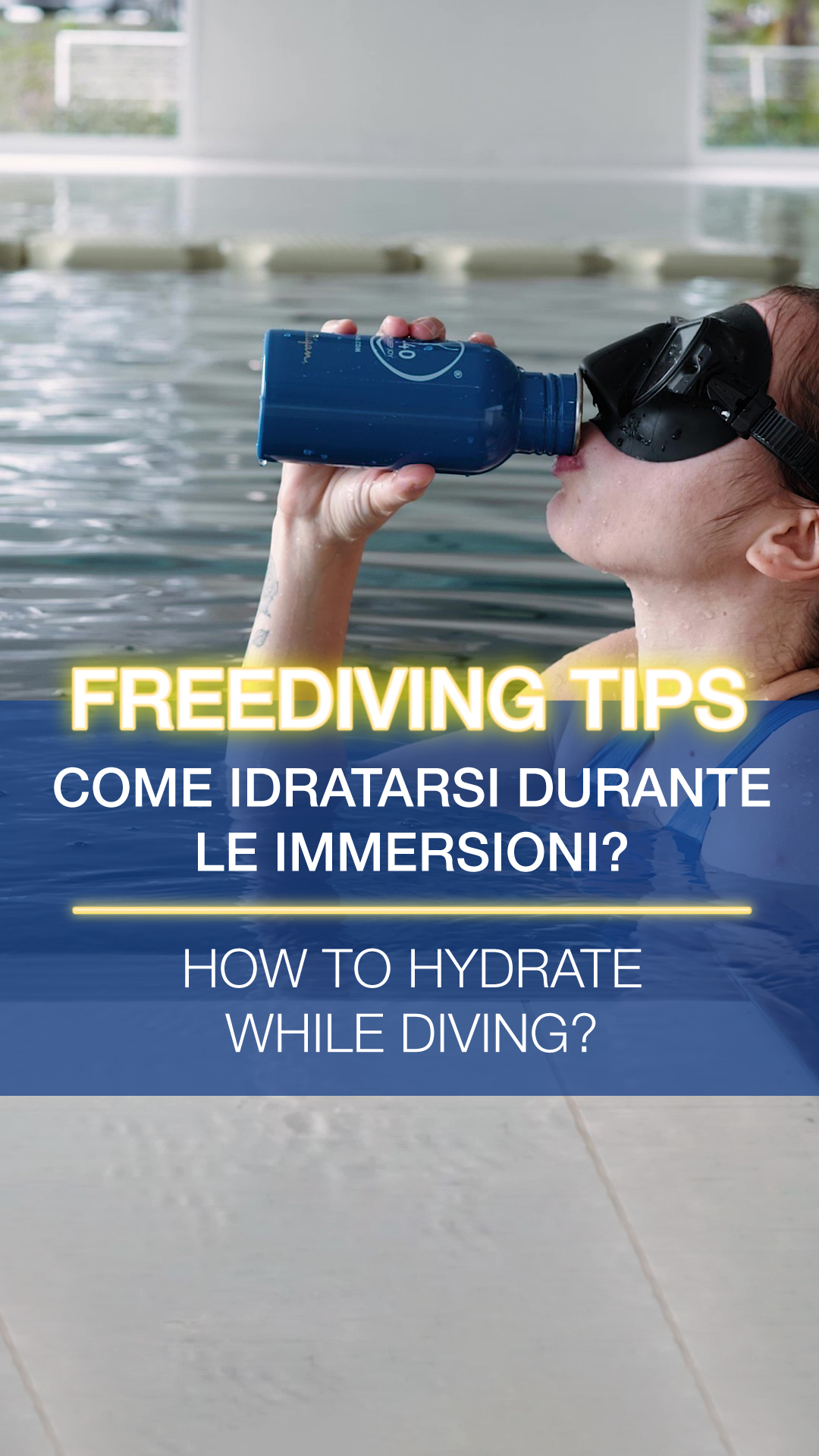
A very important safety rule often overlooked by freedivers is to hydrate regularly. The ideal would be to drink about a glass of water every 20 minutes. It is very important for equalization and for keeping body fluids as liquid as possible. When you dive deep, you lose a lot of liquids and it is important that the blood is fluid. You must be able to equalize without problems, but, if you continuously lose liquids, your fluids become dense and your body finds it very difficult to move and this can lead to serious accidents.
EQUIPMENT
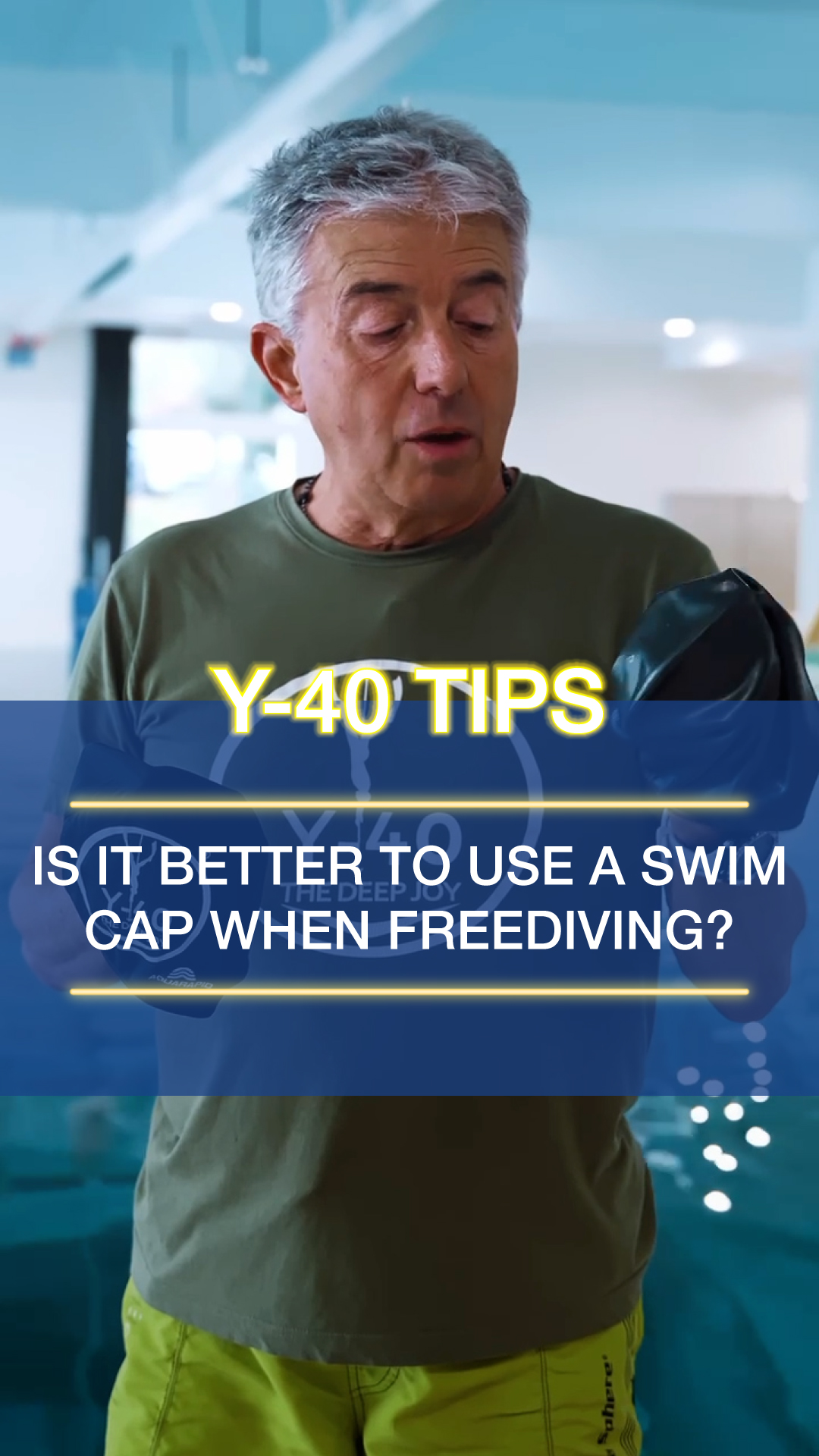
In Y-40 it isn’t compulsory to use a cap, but long hair can be a hindrance to dive. Of course, hair has to be tied for freediving, but using a swim cap is at people’s discretion. Certainly, a silicone cap or a fabric cap gather hair better and are much more comfortable. Depending on one’s preference, one should use the cap if one feels more comfortable wearing it or not. Of course, a cap that traps air or one that irritates the ears can be very uncomfortable, but this is a very personal choice.
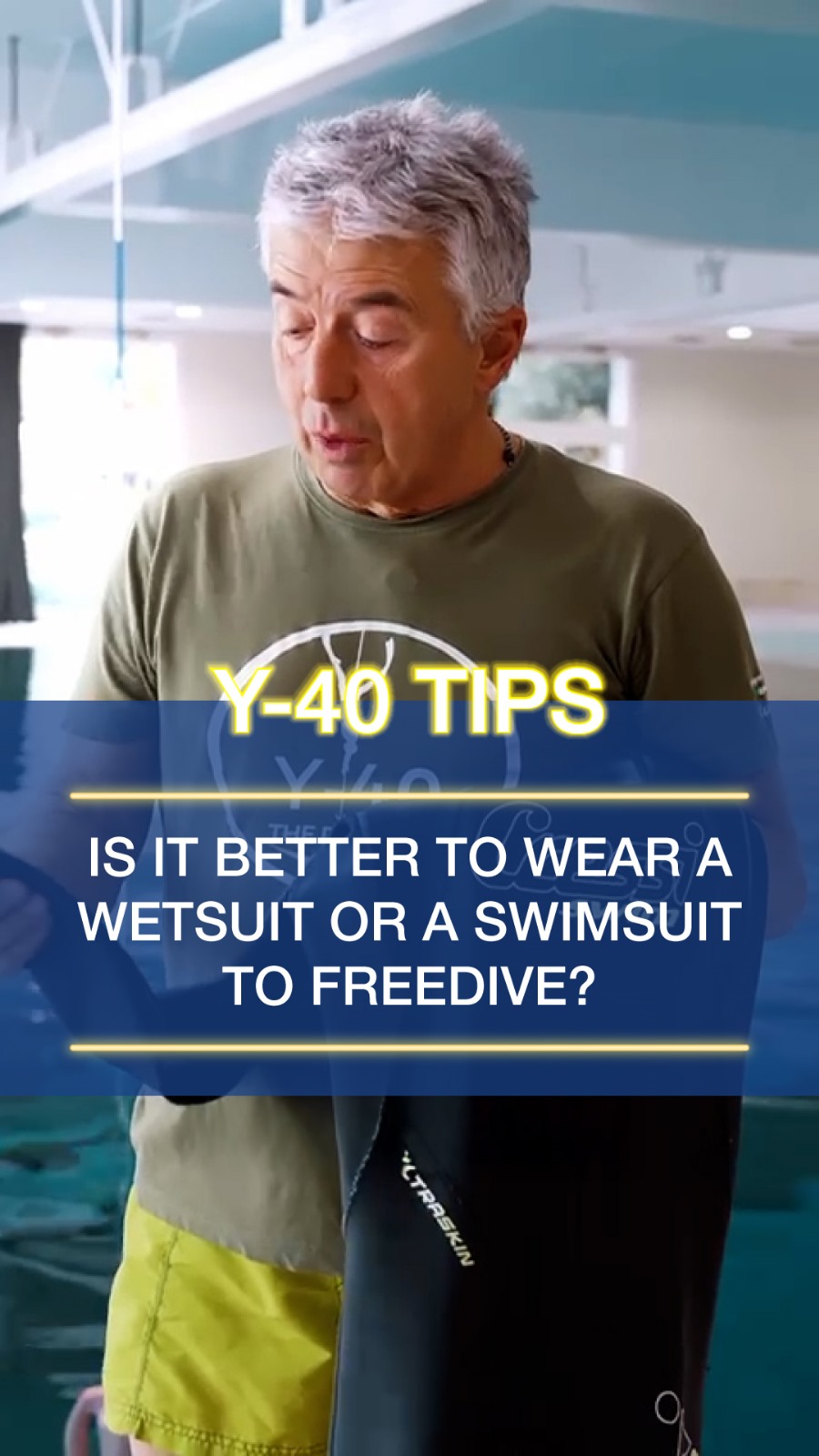
In Y-40 we have a very pleasant temperature, between 32 and 34 degrees, and the wetsuit may not be needed. But when we face open water, the difference in temperature between the upper and deeper water, or the difference between summer, autumn and winter, definitely makes us use a wetsuit. In Y-40, a 1.5 mm or 2 mm wetsuit is enough, but in the sea, the freediver generally uses a 3 mm in summer and a 5 mm or 7 mm in winter. Of course, for scuba diving where the stay has greater depths and longer time, a 5 mm, 7 mm wetsuit or even a dry suit is recommended. Naturally, the wetsuit must allow complete freedom of movement. A constricting wetsuit can be a big problem especially for freedivers, but also for those who dive with scuba tanks. The wetsuit must be snug, but not tight. When buying a wetsuit, it should be tried on, preferably even in the water, because it should not constrict movement at all.
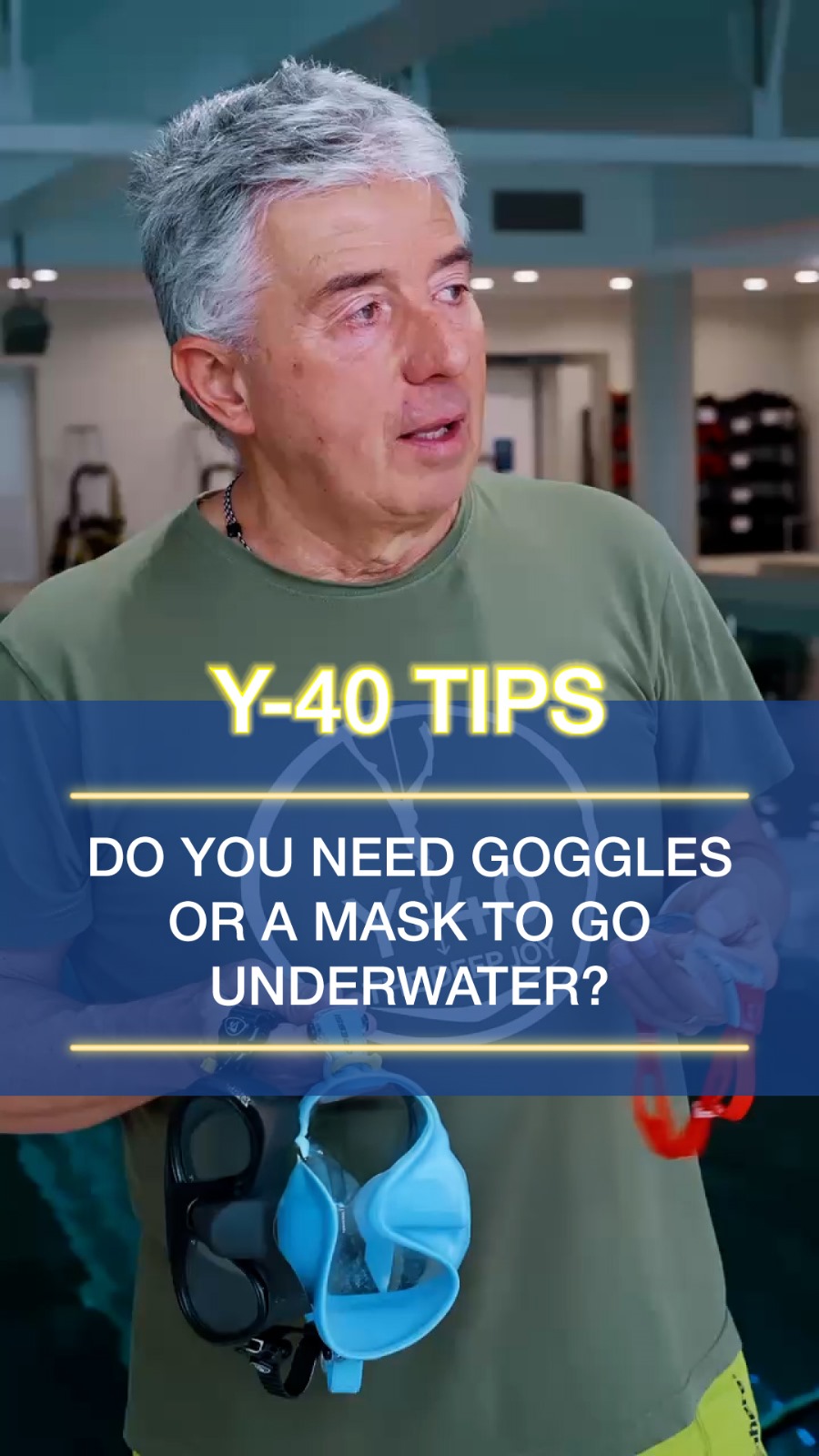
To go underwater it is always important to protect the eyes, so if we do static or dynamic apnea, goggles are more than enough, in fact they are definitely fine because they allow us, when we recover, to breathe through the nose as well. But when we go underwater, more than a metre, a metre and a half deep, it is very important to use a mask because this not only protects the nose, but also prevents us from having problems with our eyes that we might have when going down with goggles. With goggles we cannot go deep enough and we could have big problems because of the decrease in volume of the air inside the goggles. As we go underwater, the water pressure increases and the volume of air decreases: this can cause us big problems for our eyes if we wear goggles. Wearing the goggles, on the other hand, the volume of air although decreasing is compensated for by simply blowing from the nose into the goggles and this prevents us from having any problems.
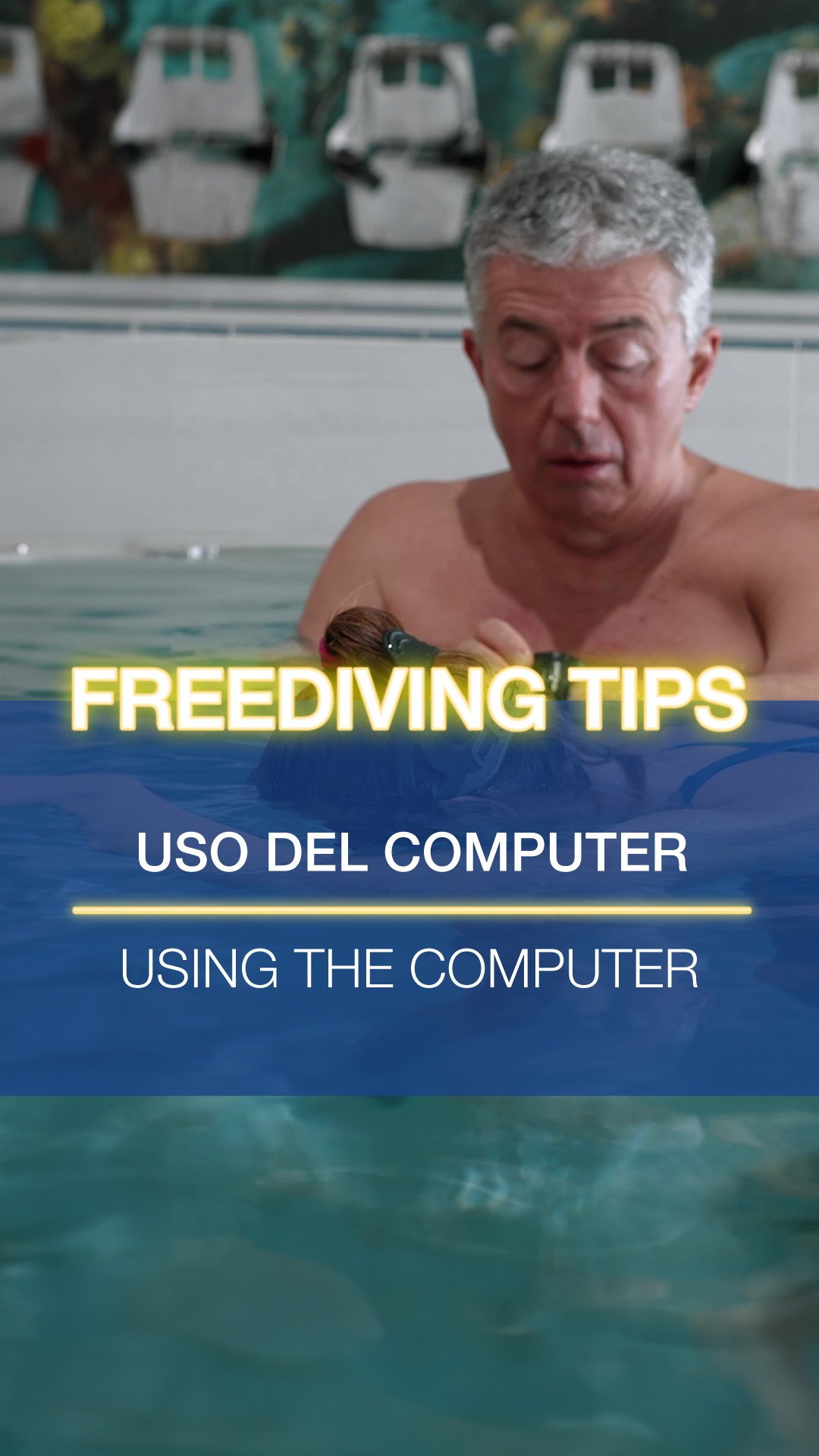
For approaching a good level of apnea it’s important to equip yourself with a computer, a faithful companion that can give many ideas to improve performance. You have to use it intelligently, not only to see the maximum depth reached or the dive time, but you can download the data after each workout and see what you have done by correlating with previous activities, to see if there has been an improvement or a worsening. The analysis of computer data is fundamental, such as that of progressively deeper dives and shorter recoveries, with dynamic apnea. We must remember to use the computer to estimate that at least three times the time of the previous apnea has passed, to avoid problems with nitrogen, our enemy even if we do not realize it.
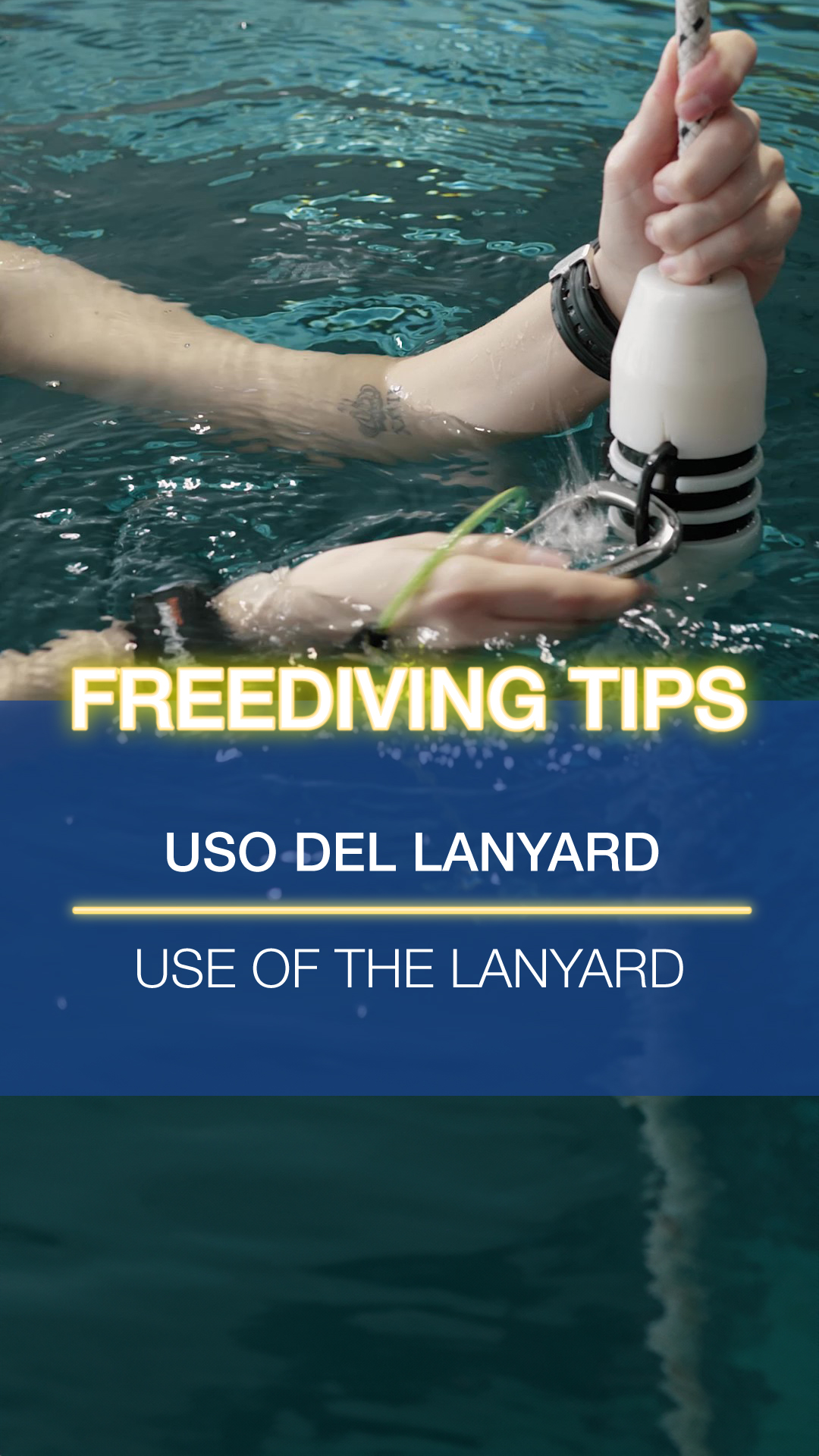
The lanyard is a fundamental security tool beyond 15/20 meters. It is important to be familiar with it. You can keep it on the wrist when you use fins, or at the ankle when you go down with arms in free immersion. It can be annoying, but if you get used to using it, it can save your life, because it helps you to stay close to the cable, makes you understand when you pull too much and helps you in case of problems in depth, so that your buddy can reach you waiting for you at a third of the depth of your dive. It must always be used and it must not be seen as mandatory, but as a tool for our safety, even in the sea.
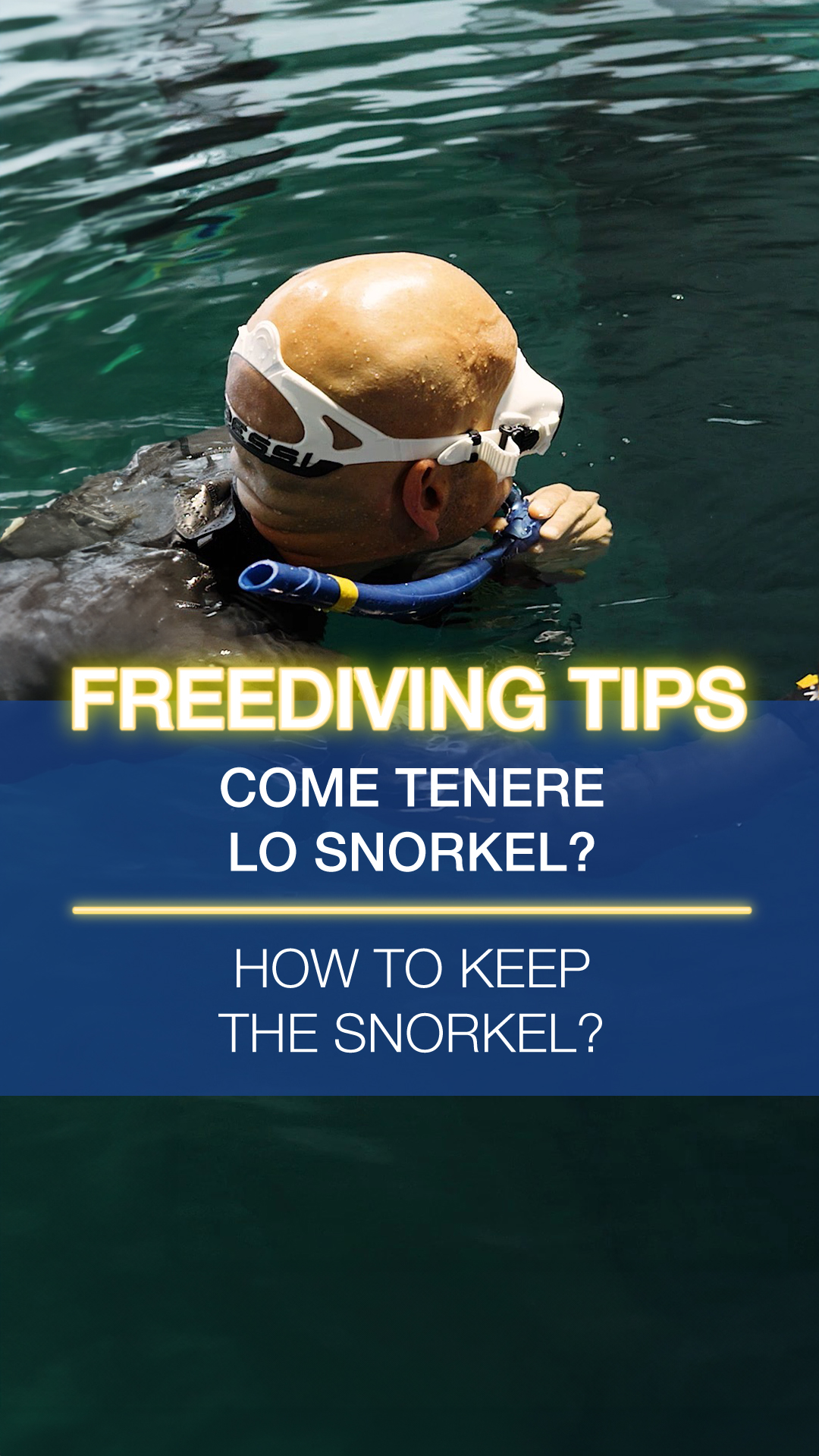
The snorkel is a tool not loved by everyone, but it is essential and makes our lives easier. Generally, people keep it on the strap near the mask, but it would be better to wear it in the back position, behind the ear. It is important to always have a snorkel to continuously check, while breathing at water surface, what happens underwater. Many people do not use it. We can consider them “selfish”, because they only worry about their own dive without considering the safety of others, which is fundamental.
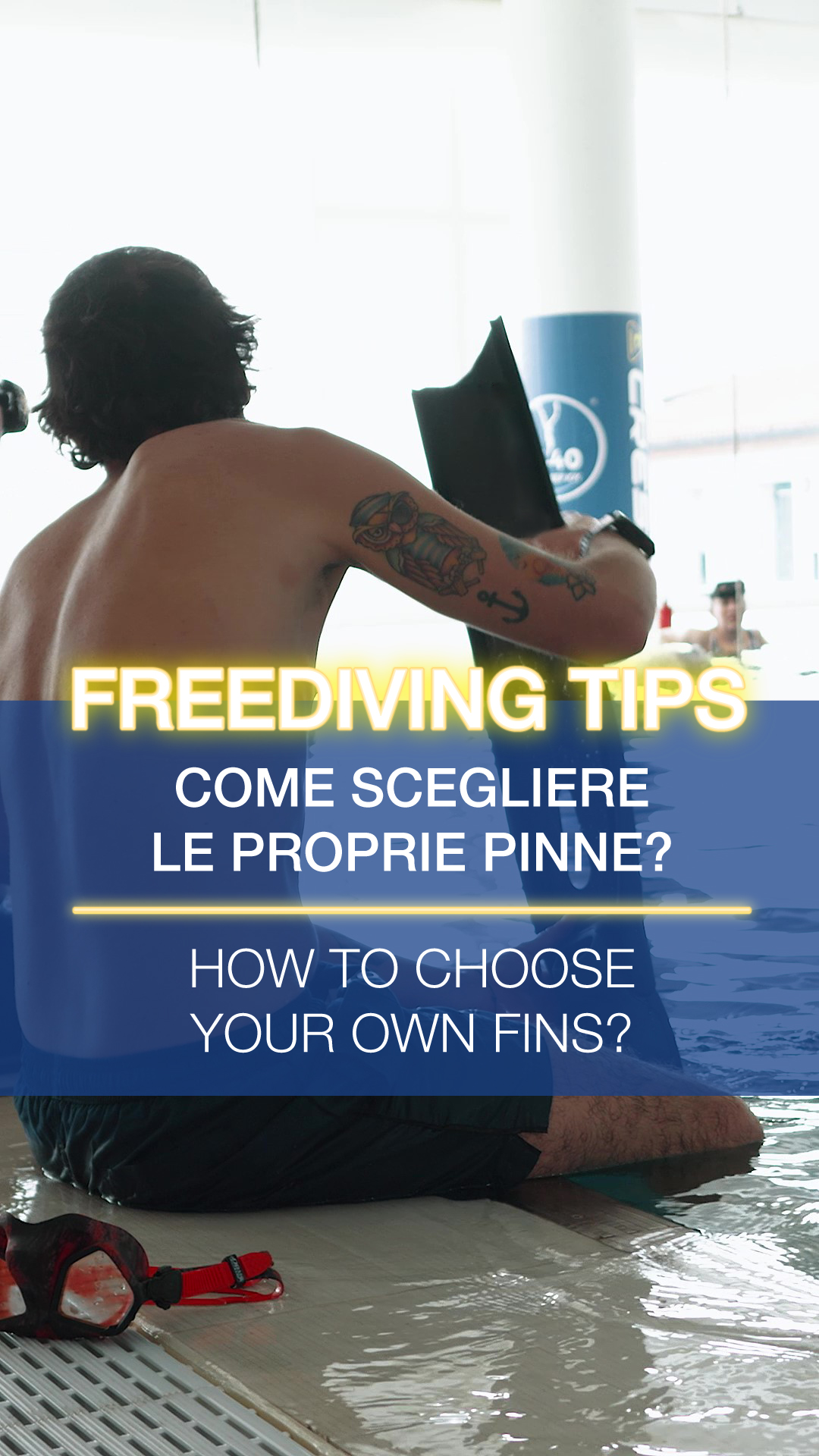
The choice of fins is not a matter of aesthetics, but of technique. Many freedivers choose rigid fins, as was once the custom. Now, thanks to new materials as carbon or fiberglass, the most technically advanced freedivers have moved towards lighter fins. It’s better to choose a model appropriate to your body weight, because, for example, a light fin is not suitable for a slim body. Generally, a soft fin is efficient anyway, but to be controlled well, you need to have a good movement technique. However, there are price differences between plastic fins and carbon fiber or glass fins, and this discriminating penalizes beginners. On the market you can find, however, light fins at an affordable price: the “entry level” model. Here at Y-40, there is the possibility to try them both in plastic and carbon.
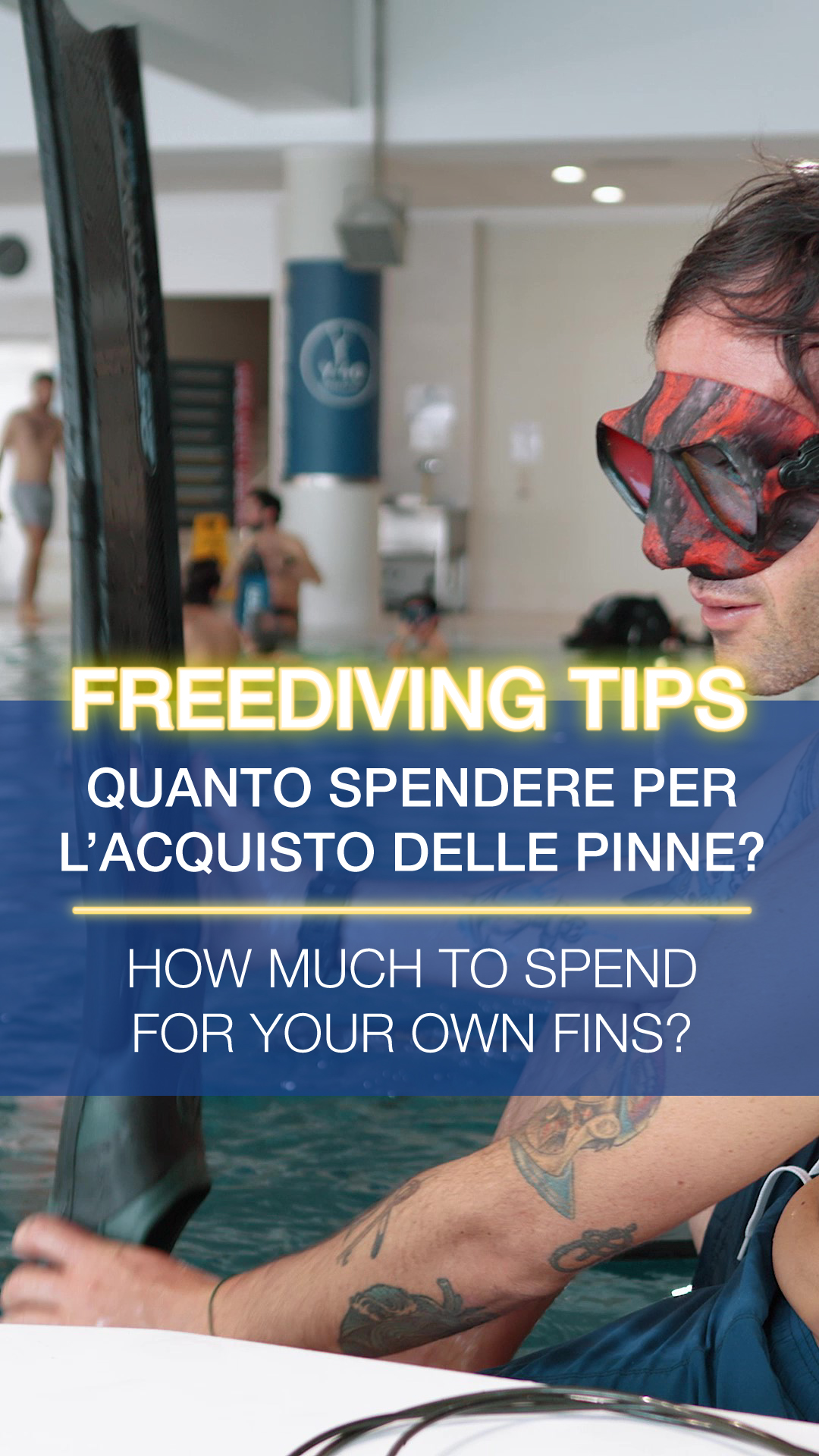
There are price differences between plastic fins and carbon fiber fins, and this discriminating factor penalizes beginners. On the market you can find, however, light fins at an affordable price: the “entry level” model.
There are big price differences between plastic fins, which cost around € 100, and carbon fiber fins which can cost over € 300. It’s not easy to buy fins without trying them first, here at Y-40 we have the opportunity to try them for free, included with entry to the pool, in this way a person can choose the most suitable model.
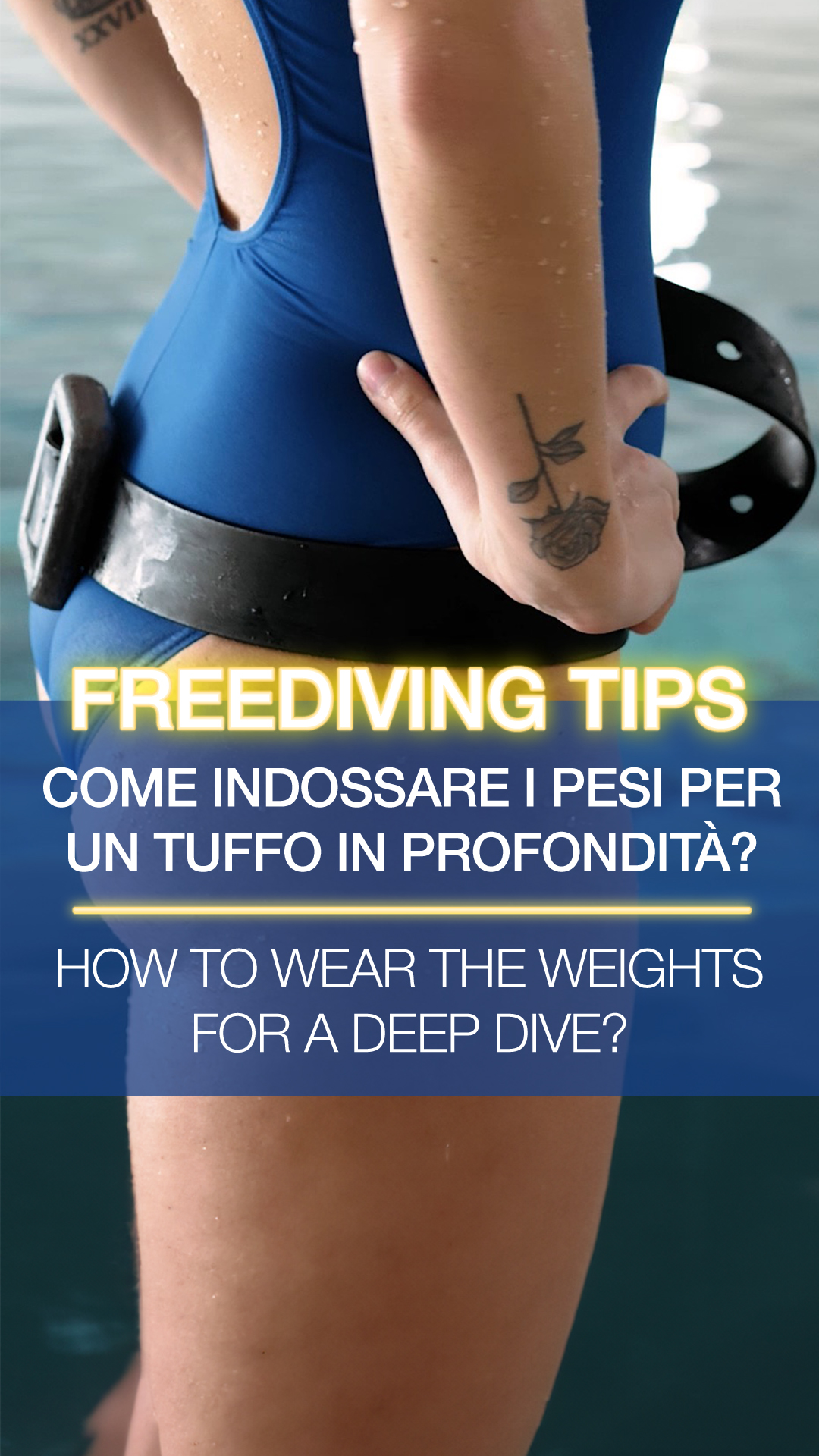
The weights should be positioned in a balanced way around the body, better if not on the front of the belt. It’s better to place them on the side or on both sides of the person, always in a balanced way, 1: 1, 2: 2, or with small weights of half a kilo. The belt must be elastic, so if we pull it slightly it will always remain tight to the body and lowered around the hips.
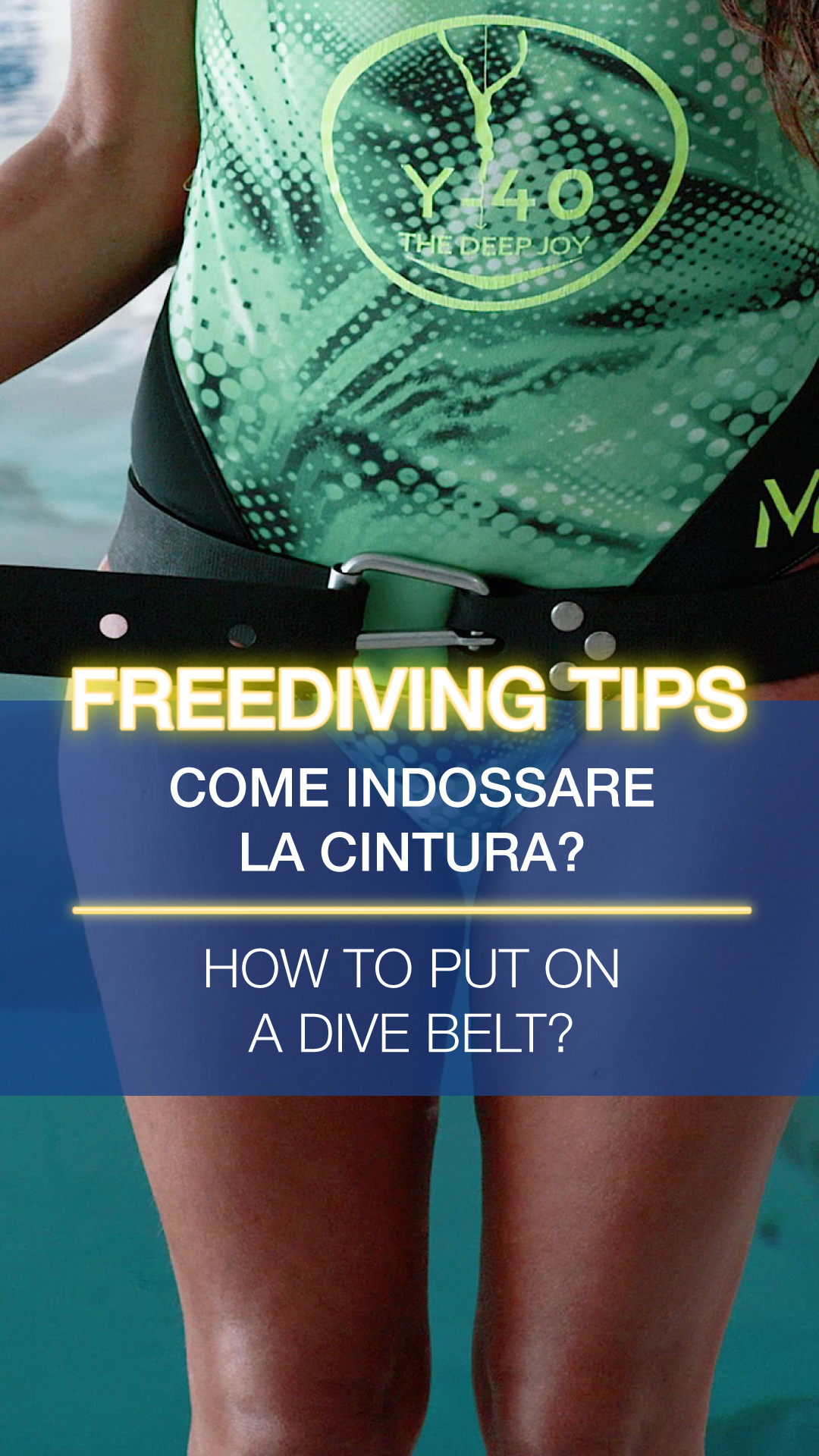
A very important warning is not to pass the strap below your belt. It is necessary to leave the protruding flap free. So, in case of emergency, by pulling it, the belt will fall free and you can reach the surface.
STATIC APNEA
It seems very simple. You let yourself lie face down on the water and try to stay relaxed. The tricky part is that in our usual activities we are used to doing something. In static apnea there is absolutely nothing to do and many people find it uncomfortable to do nothing, because our brain is always busy trying to do something. Being able to stay relaxed for a long time can be challenging. Usually it takes more static apnea sessions to get to an acceptable level of emotional and physical relaxation, but when you reach a good performance the statics apnea can give you a great satisfaction.
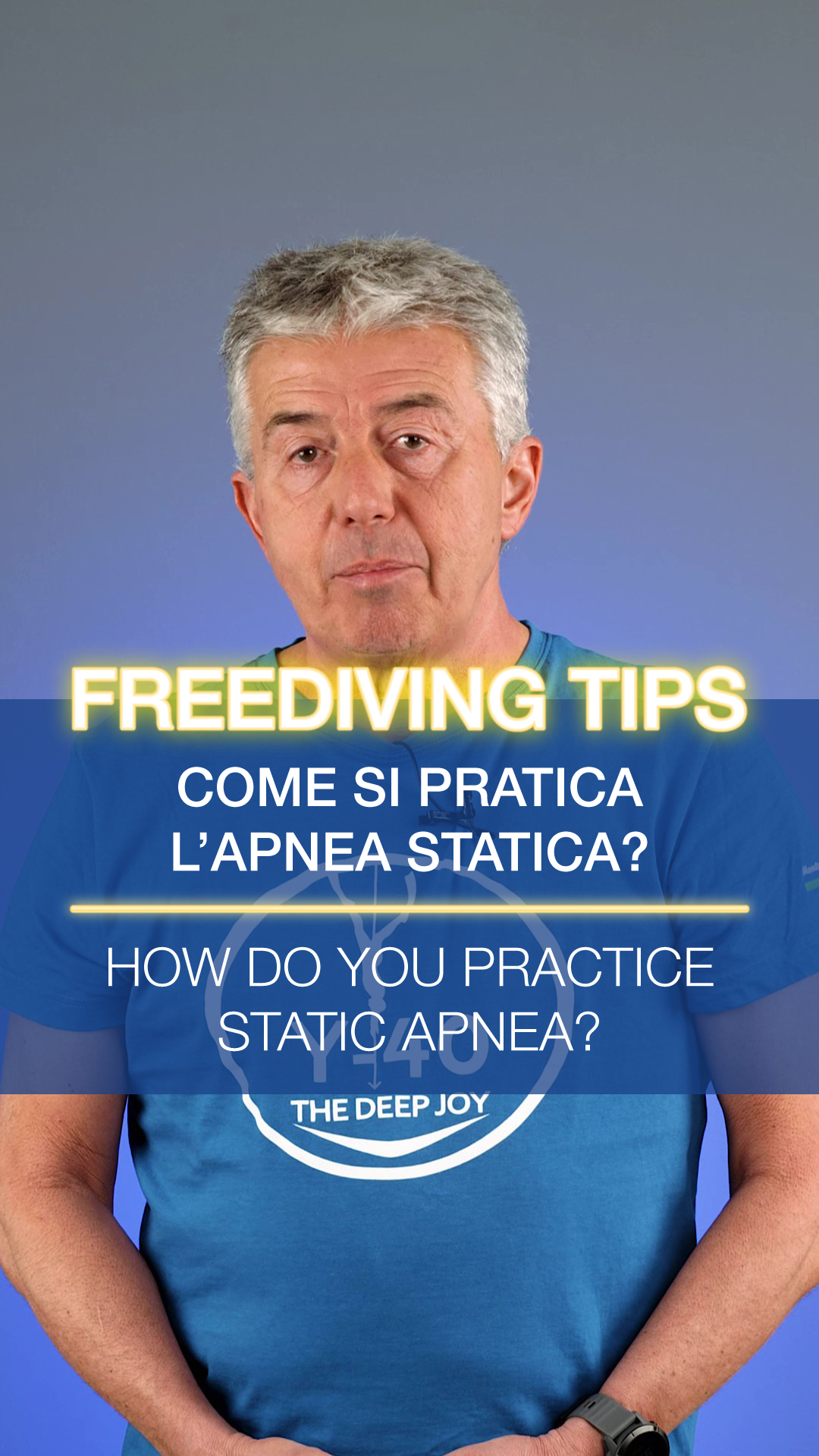
You should prepare by breathing for a couple of minutes immersed in water up to the neck with your mask on the forehead. When there are just a few breaths left, you have to put on your mask. After taking your last breath, slowly slide forward trying to keep your limbs completely relaxed. The instructor verifies and ensures safety, control the time and the muscle tensions, which are the most important part of static apnea. The students learn to recognize if there are parasitic muscle tensions that take away their energy and oxygen and push them to breathe sooner.
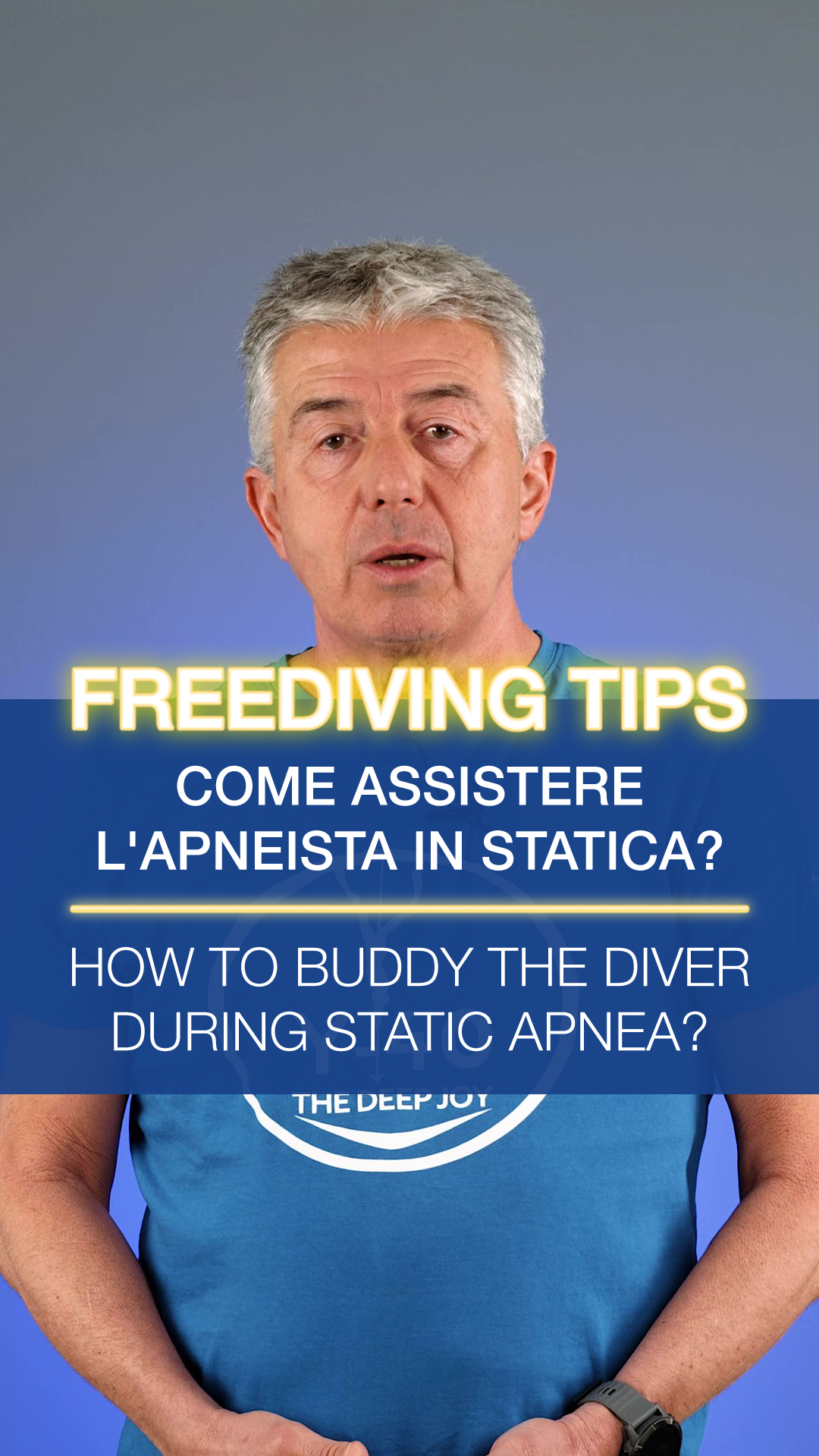
Monitoring the diver who is practicing, knowing what’s the set time and the risks that may be involved. It’s very important to be closely supervised when doing exercises in the water and to be able to understand the status of the person who is practicing, to be able to help and possibly rescue him when he runs into any problems. The buddy should periodically check that the diver responds to the signals. The buddy should tap on the shoulder and the diver can simply lift a finger to show that everything is ok. This is very important for safety.
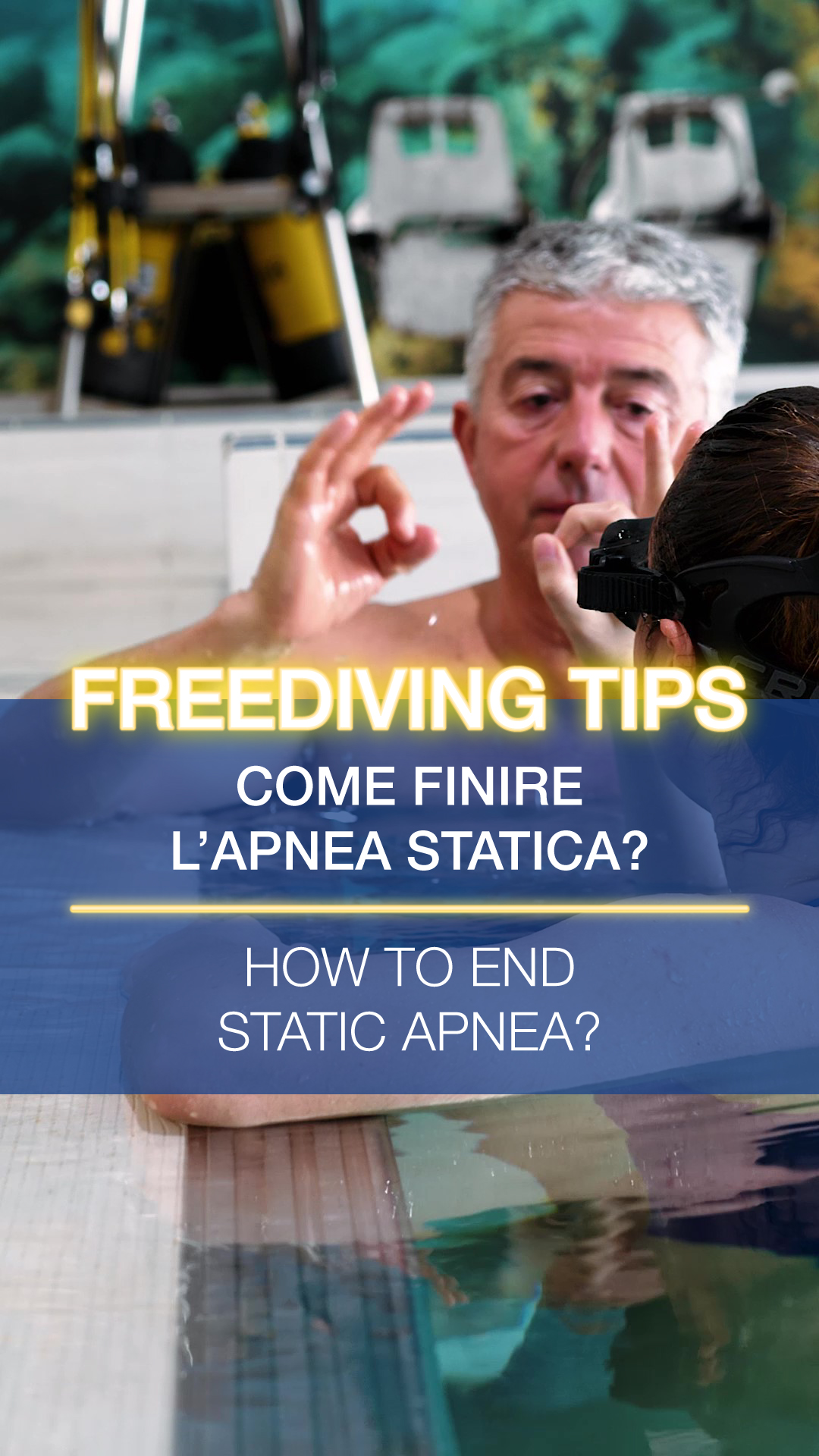
When the diver starts practicing static apnea with his buddy, it’s better if he places a hand on the edge of the pool so, when he ends, he can very easily lift his head to begin breathing, instead of floundering in case of a too long static apnea or accidental inhaling of few drops. Normally instructors always do this to prevent any problems and the diver usually feel safer having a hand resting on something stiff.
DYNAMIC APNEA
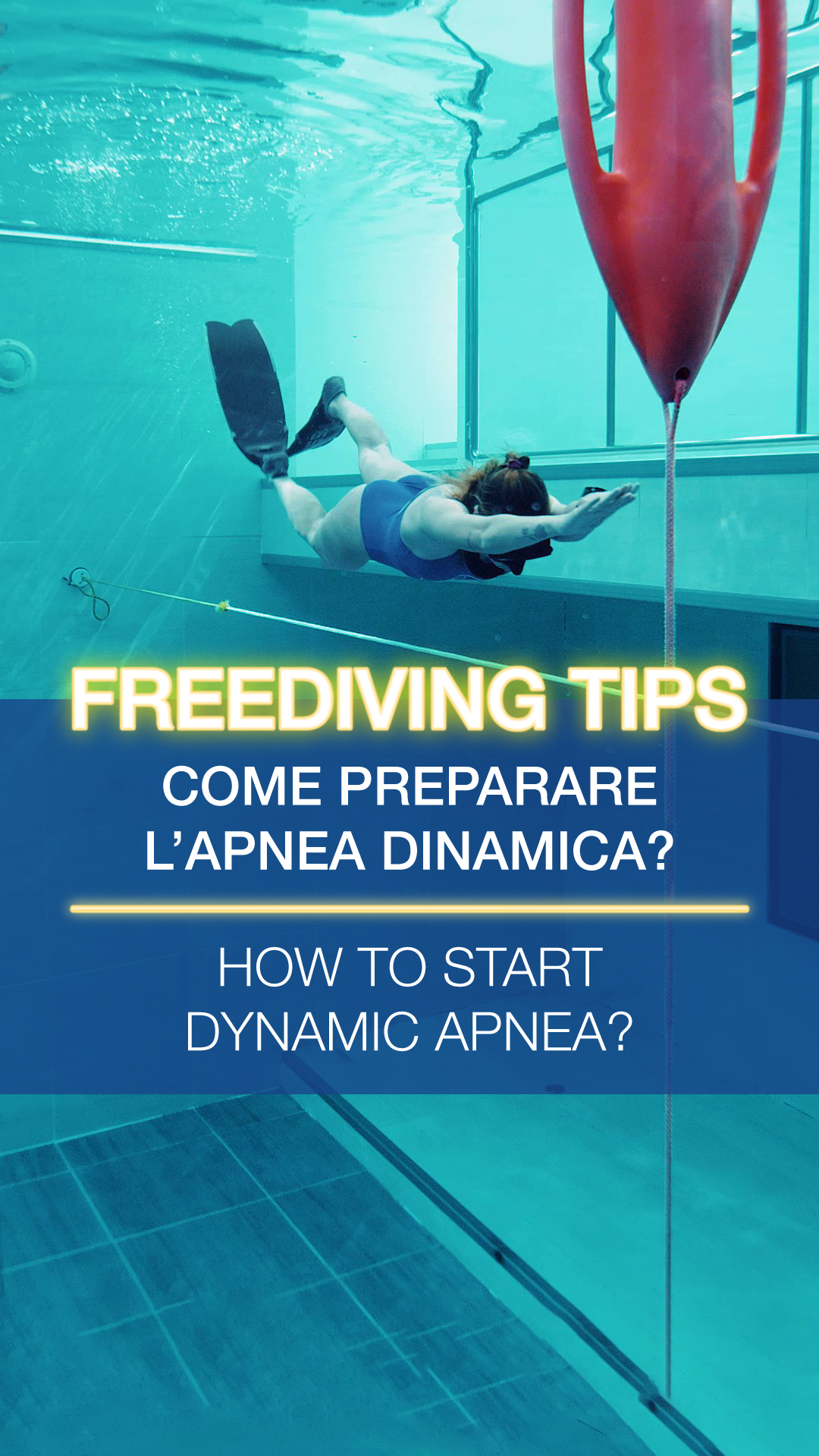
Generally, the preparation is like the static one. The diver has the head outside, he breathes calmly, he wears a neck ballast that allows him to be completely neutral underwater. The distance can be short or long, but it’s important to start completely relaxed, with the lowest metabolism possible. The start is made either by sinking or half duck dive, but it’s important that the diver starts with the lungs full of air and without excessive muscle contractions.
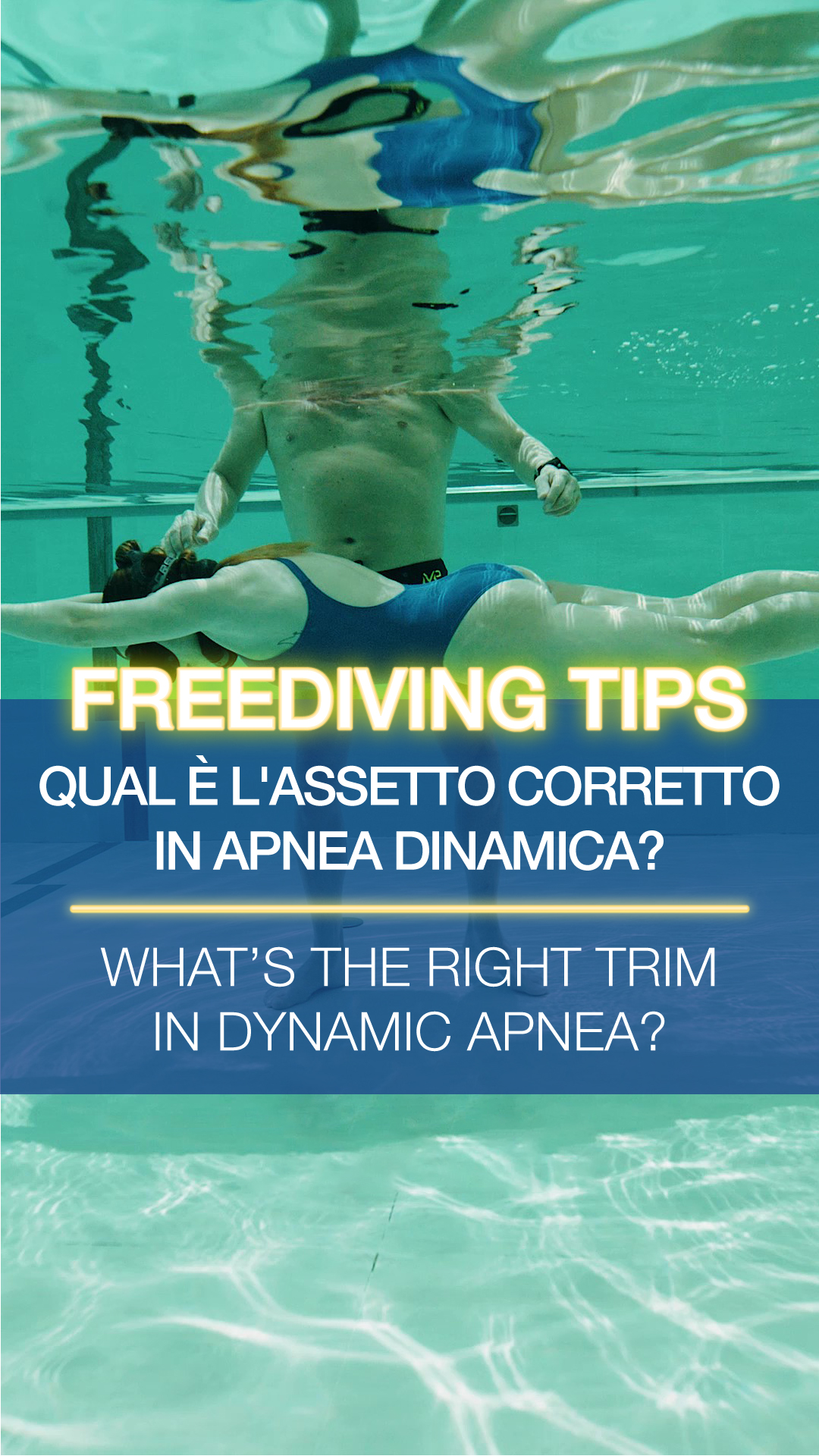
The right trim in dynamic apnea is important because the diver hasn’t to float or sink too much, so that in every movement he can go straight without having to fight against a vertical component, which pushes him up. For this reason, neck weights are generally used, which allow to remain absolutely neutral. This also helps to increase the distance travelled by 15/20%.
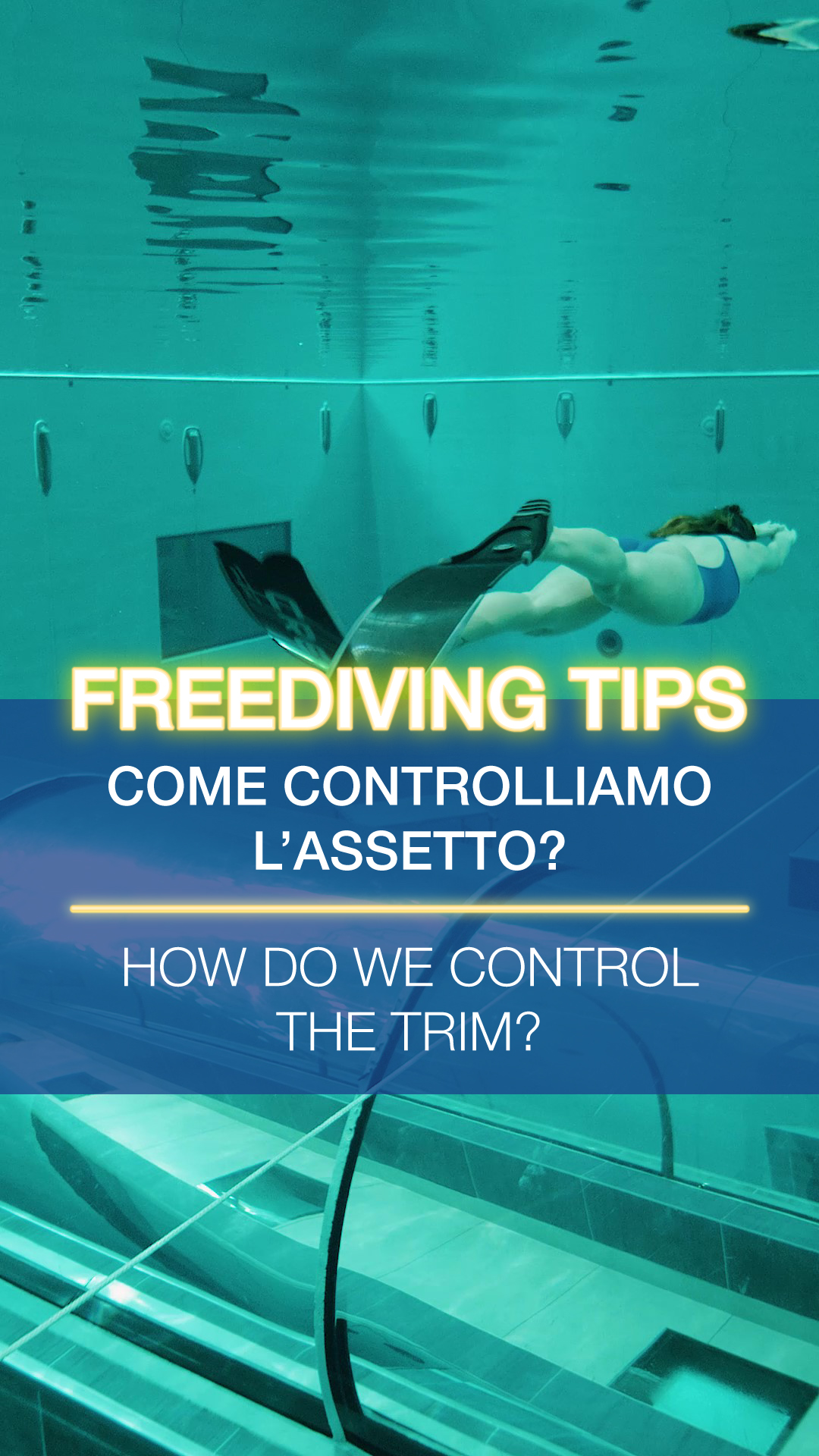
How do we control the trim, if neutral, positive or negative? Simply keep a certain distance from the bottom in dynamic apnea remaining stationary. If we have an exaggerated positive component we will float immediately, but if we are too negative we will sink quickly. If we are neutral instead, as preferable condition, we will be able to remain half water without any movement. It’s better because in this case we will be able to go forward without controlling anything, having a push that takes us forward keeping the more effective hydrodynamic profile.
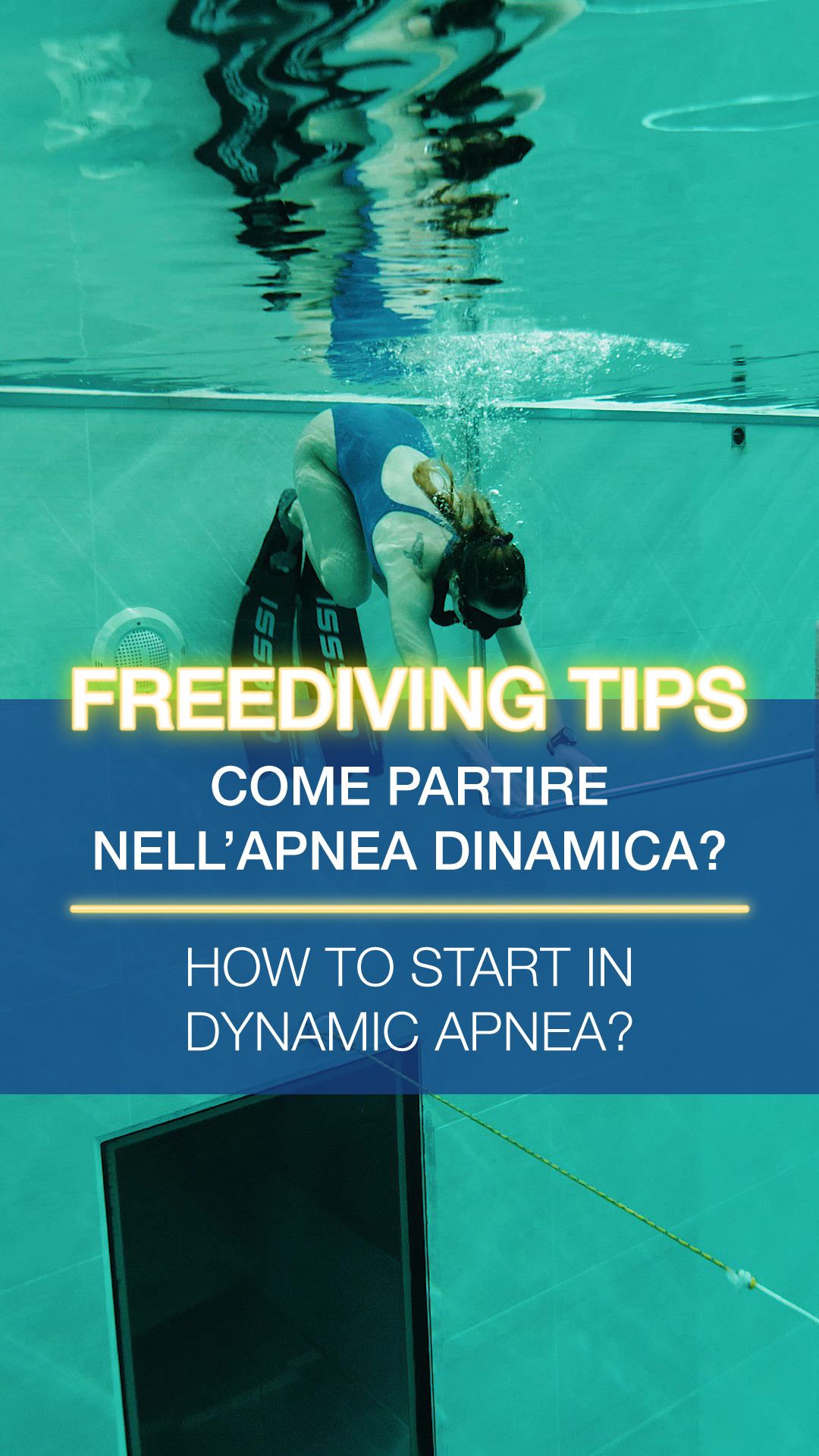
The start in dynamic apnea can be done in two ways. A very simple way is to do a half duck dive: you push slightly from the edge and sink to the desired depth to begin to kick with your fins. This is how you start usually. Then there is instead a more competitive way: sinking, then spinning and pushing from the edge. But the push from the edge, unfortunately, with the fins, with the equipment, or the monofin can be quite difficult because the fins do not allow a great push. It’s not possible to go very far, like in pure swimming where a swimmer rests his feet and pushes himself very vigorously. The equipment gives big problems of tightness on the wall and it’s not possible to have a big push from the wall and the rebound is usually not very effective.
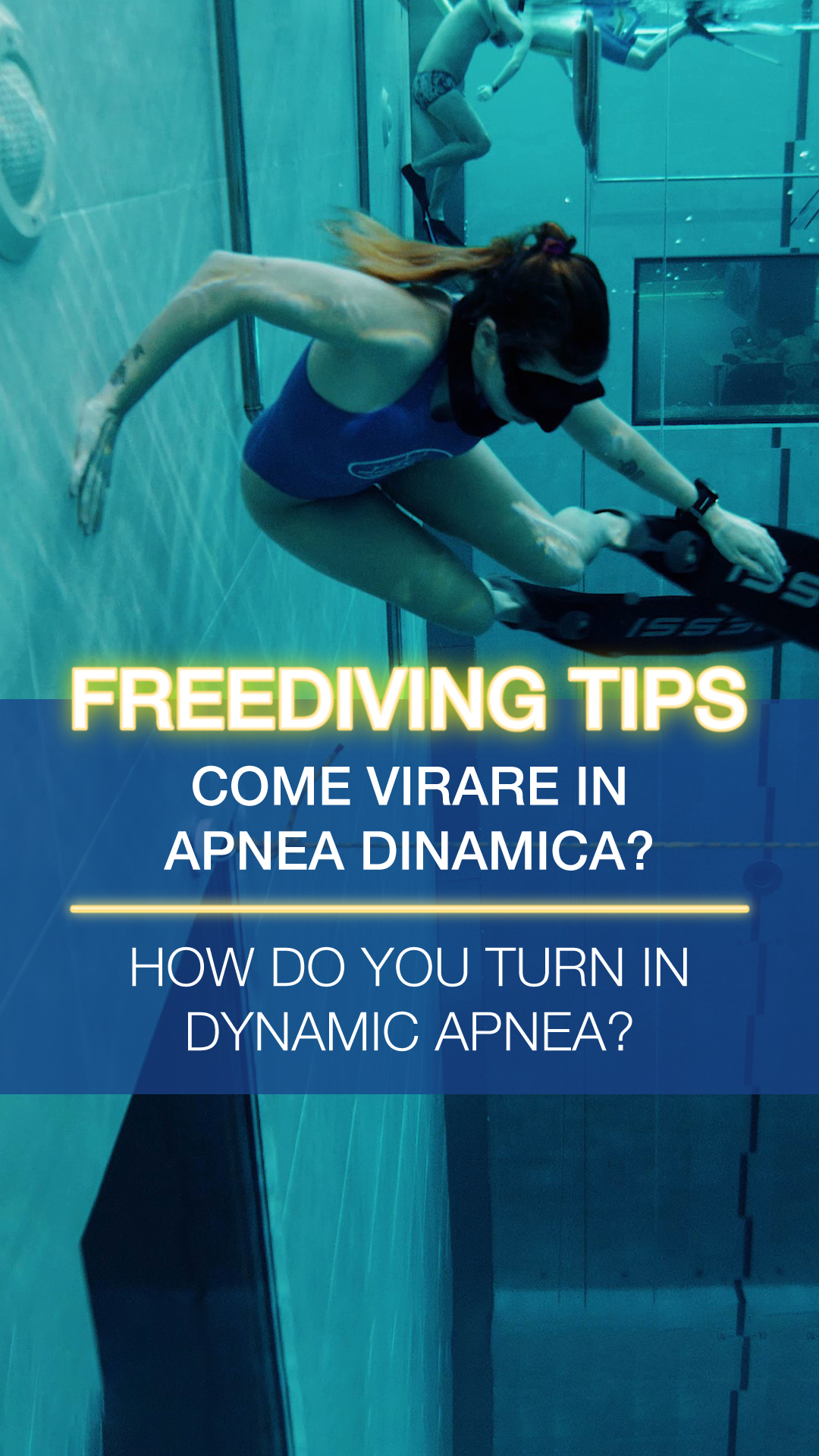
The turn is always a very complex movement in dynamic apnea. It’s a break in the rhythm and it’s complicated for finswimmers and freedivers. When you turn, you are always completely immersed in water, you get close to the wall with a good speed and you stretch an arm to touch the wall. The arm is used to rotate the curled up body. Push with the heels against the wall and try not to lose too much energy. It’s very difficult to recover the energy, like a rebound in pure swimming: it’s always a complicated moment.
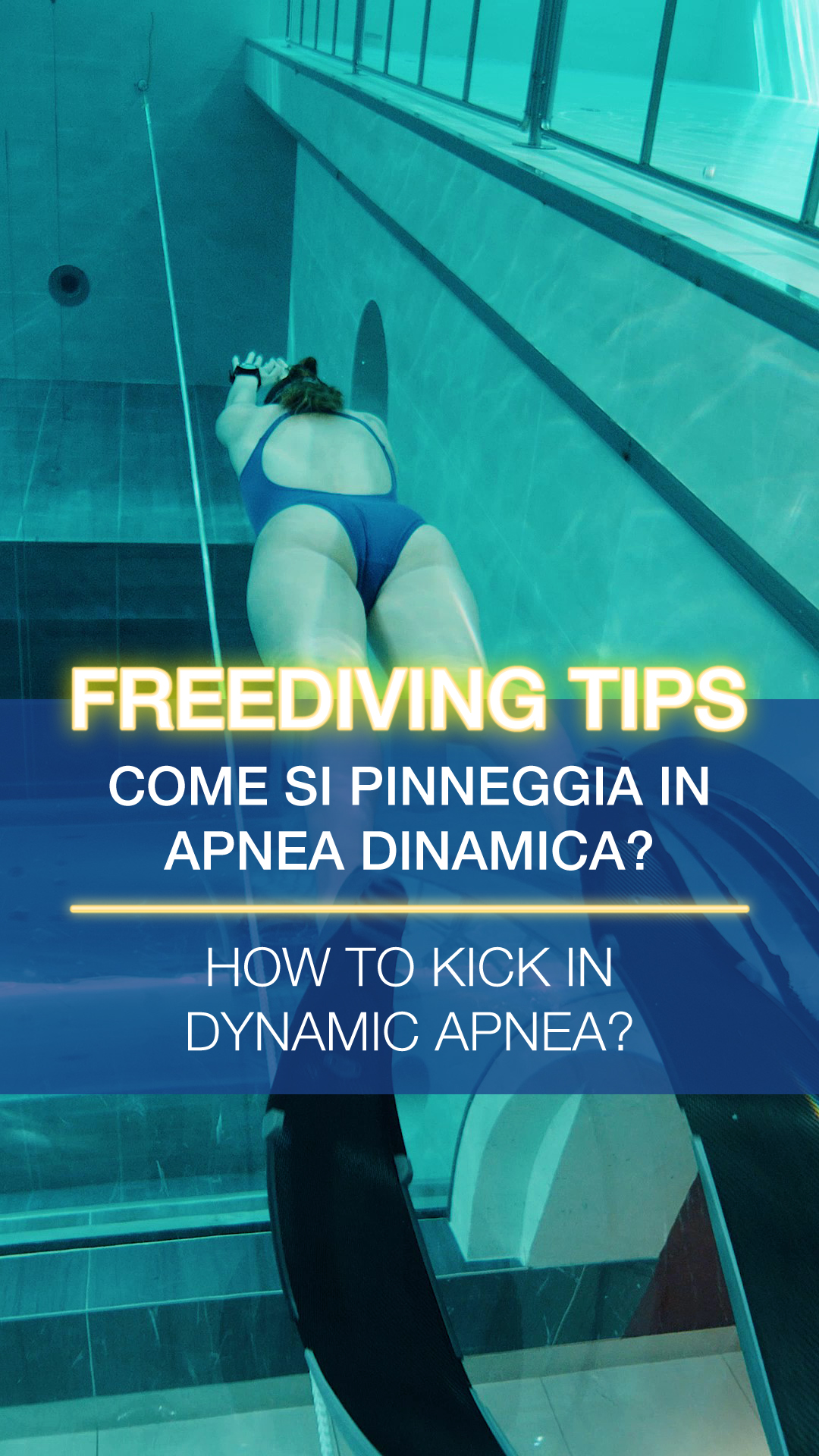
Kicking with fins is a simple movement in dynamic apnea, but not so many people can do it perfectly. The ideal would be to balance the thrust with the two legs simultaneously forward and backward. If the opening is too high, we have resistance problems. If the opening is relatively short, we have a very good feedback. It’s the trunk that cuts the water. If the legs move into the range of the trunk perfectly straight or almost, with the ankles very stretched, the tips of the feet push down to get the maximum result. If the distance between the feet in the antero-posterior direction is about 25/30 cm, it is the best.
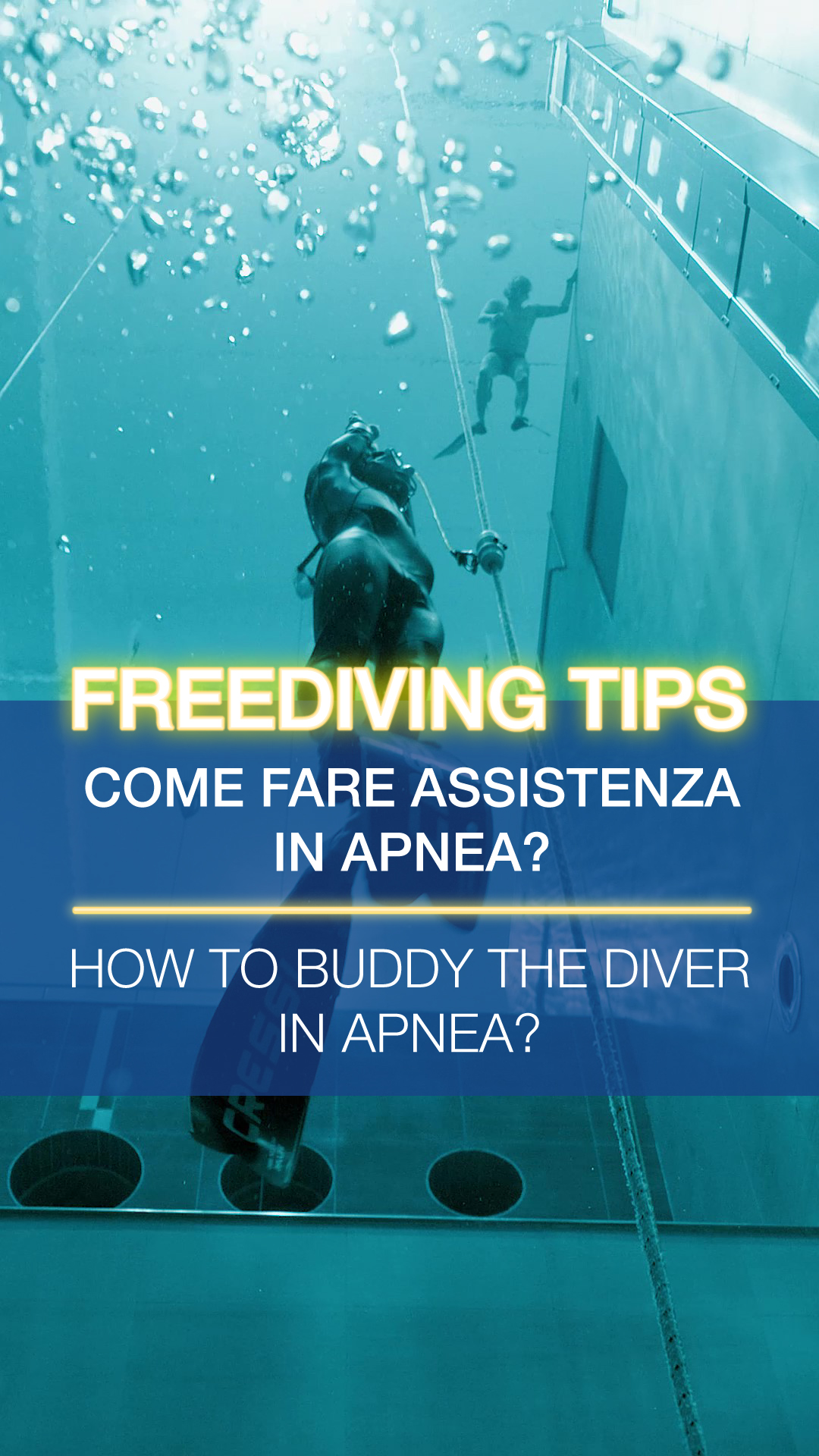
It’s important to know to be safely supervised by someone who knows what are you doing and what could be the difficult parts. The freediver is usually followed by a buddy on the surface, ready to intervene when complications arise. Especially when doing hard apneas, or trying to reach a ceiling, or having heavy workouts, the presence of a rescuer nearby is essential.
APNEA IN ASSETTO COSTANTE
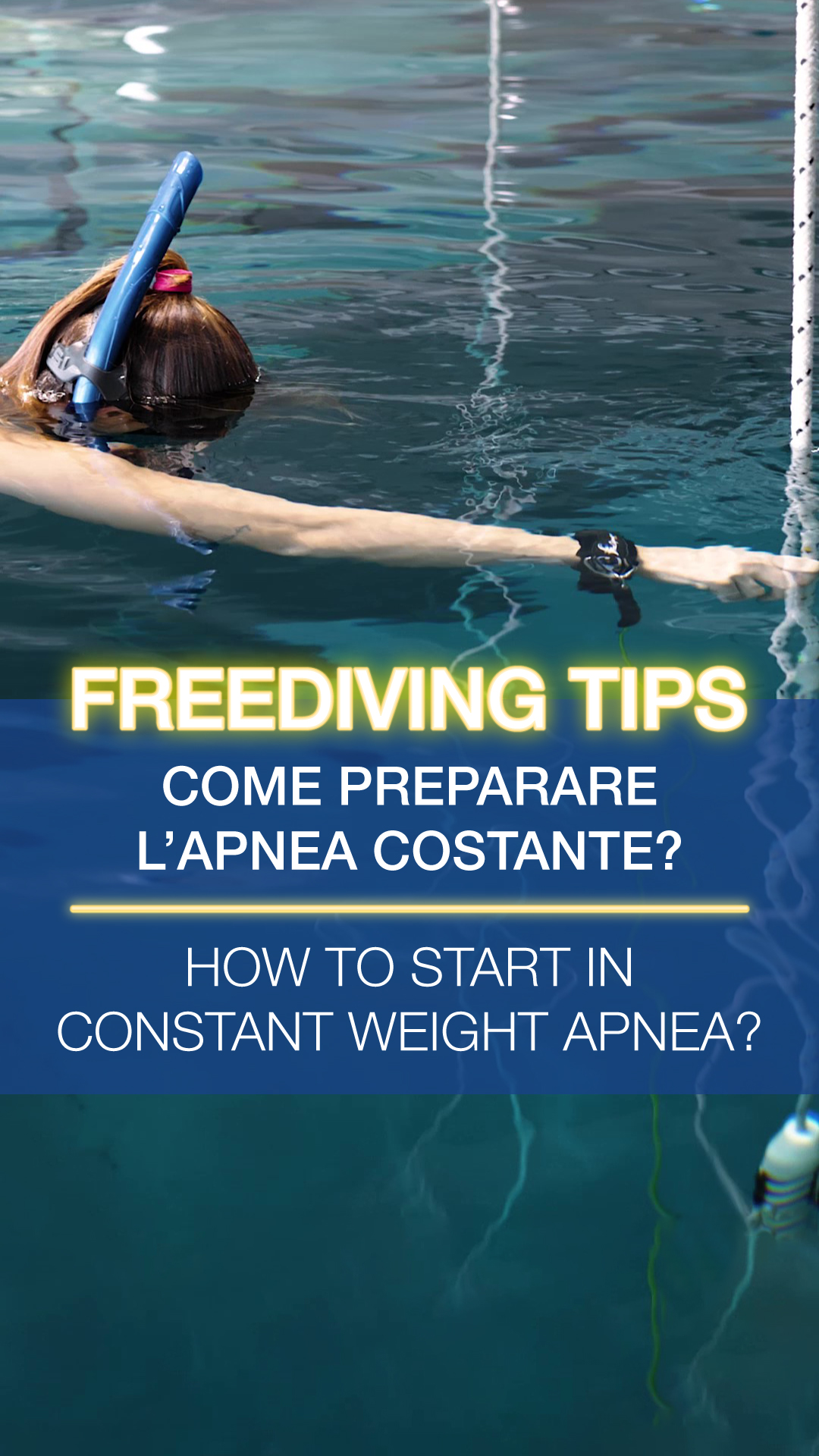
It’s not easy to start a dive in constant weight: first of all, you should understand if you have rested from the previous dive. You should stay on the water surface completely relaxed and breathe thanks to a good buoyancy. If you wear the wetsuit you have positive buoyancy, if you are in Y-40 without wetsuit, you should use floats and when you are ready and have completely lowered your metabolism, you should begin to breathe, either near or far from the rope. When you’ll have reached a good level of relaxation and rest, floating with good diaphragmatic breathing, you’ll been accompanied by your buddy to attach the lanyard to the rope, start equalizing, then duck dive and begin your dive.
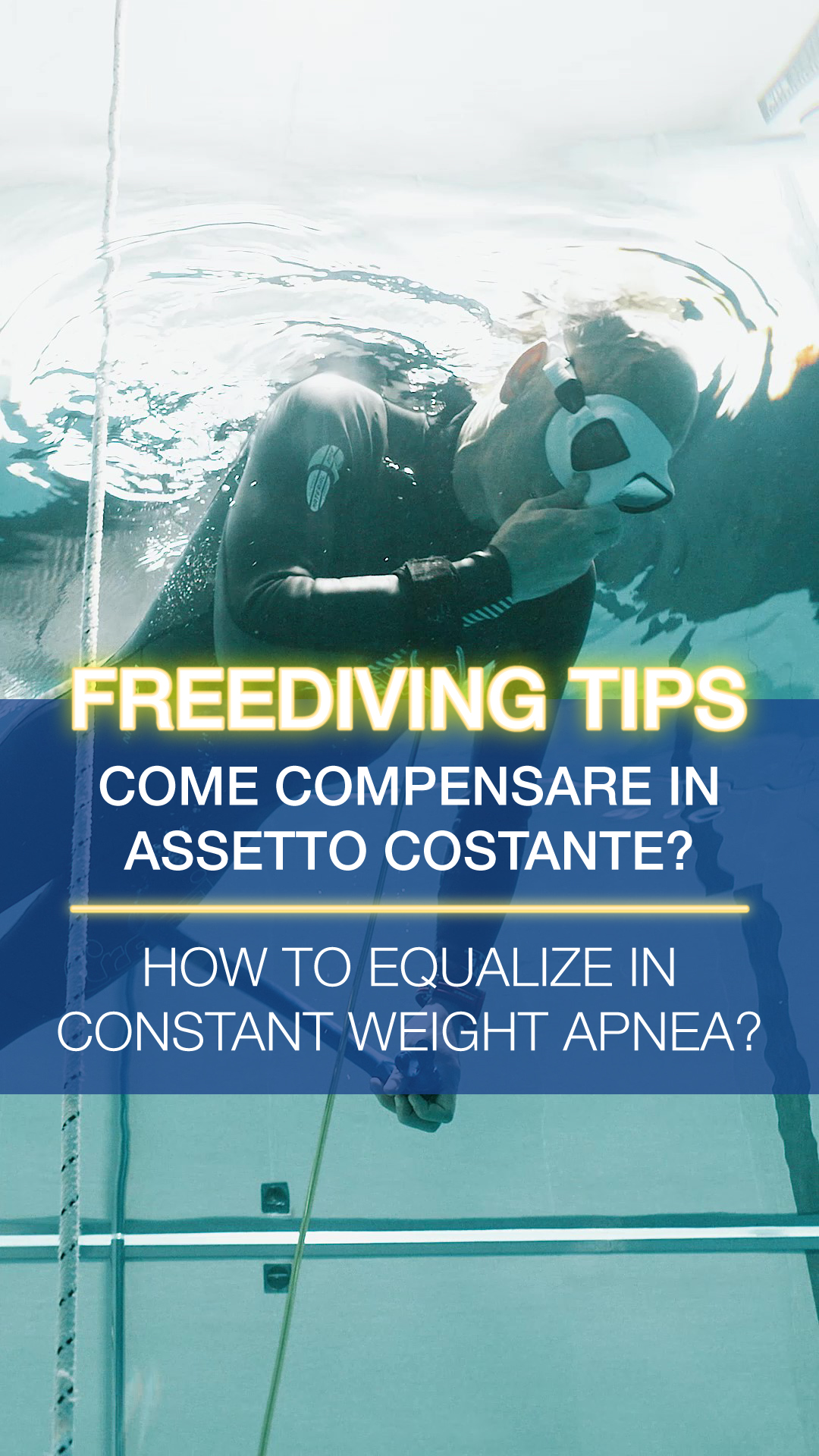
Equalization is always a problem for deep freedivers, but it’s important to start equalizing before you need it, so you should focus on equalizing before performing the duck dive and equalize continuously during the descent without feeling the need to do it. If you wait too long, the pressure difference from the last equalization will become quite high, you will make a considerable effort and your eardrum could gradually get tired and feel bad.
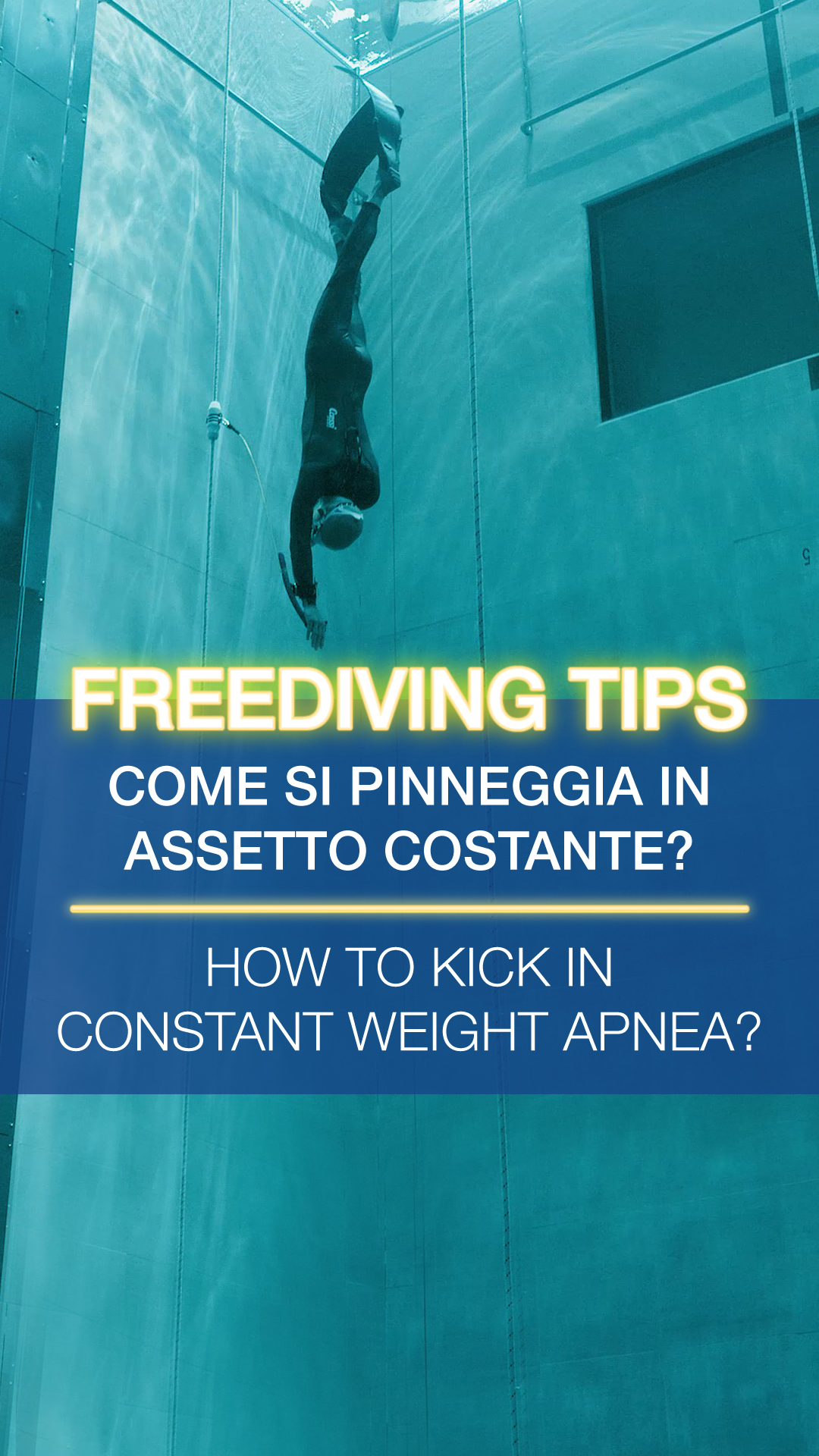
The kicking in constant weight is not very different from the kicking in dynamic apnea. The difference is the weight and the power you have to give to the fins that vary according to your buoyancy. At the beginning, having a lot of buoyancy, you should exert more force, but after a few metres, 10 metres more or less, you’ll be able to give less power to the fins and after a while, 15 metres more or less, you’ll start to fall. It’s always important to have a hydrodynamic profile as narrow as possible, but it’s important also not to apply excessive force to the fins to avoid consuming too much energy during kicking, because this could affect our oxygen consumption and the production of CO2, which makes you want to breathe much sooner.
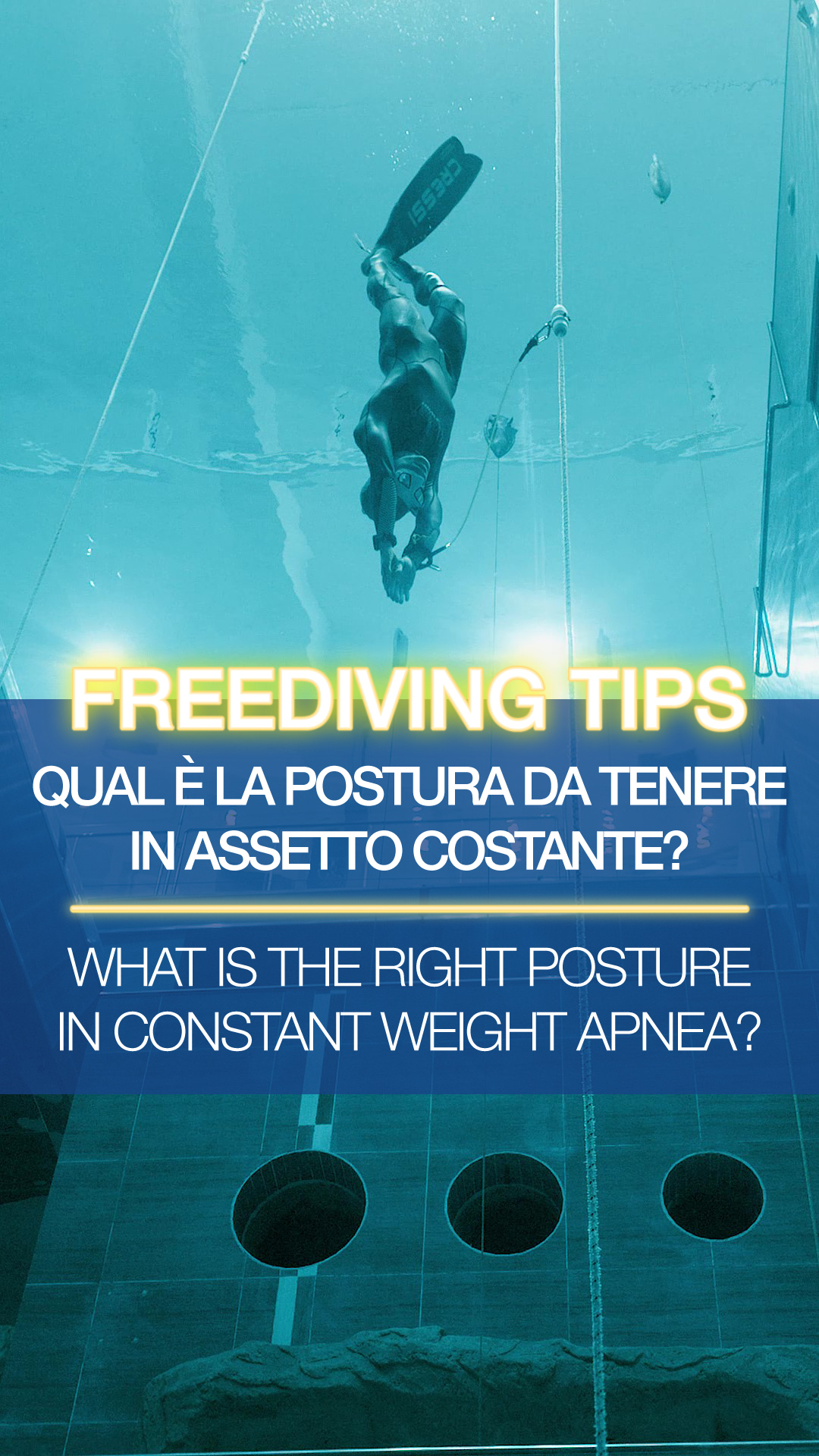
The right posture in constant weight is one of the great problems that freedivers have. Generally the freediver has to stay well aligned with the rope, but freedivers usually keep their head hyperextended to look downwards and it complicates the whole body position. The legs kick while standing backwards and the descent is generally arched like a banana shape. Instead, the best thing should be to be able to remain relaxed, with a soft neck, and this certainly favors easier equalization. The fins and legs have to be completely in line with the body to kick in the right direction, without adjustments by the trunk that must be loose and relaxed.
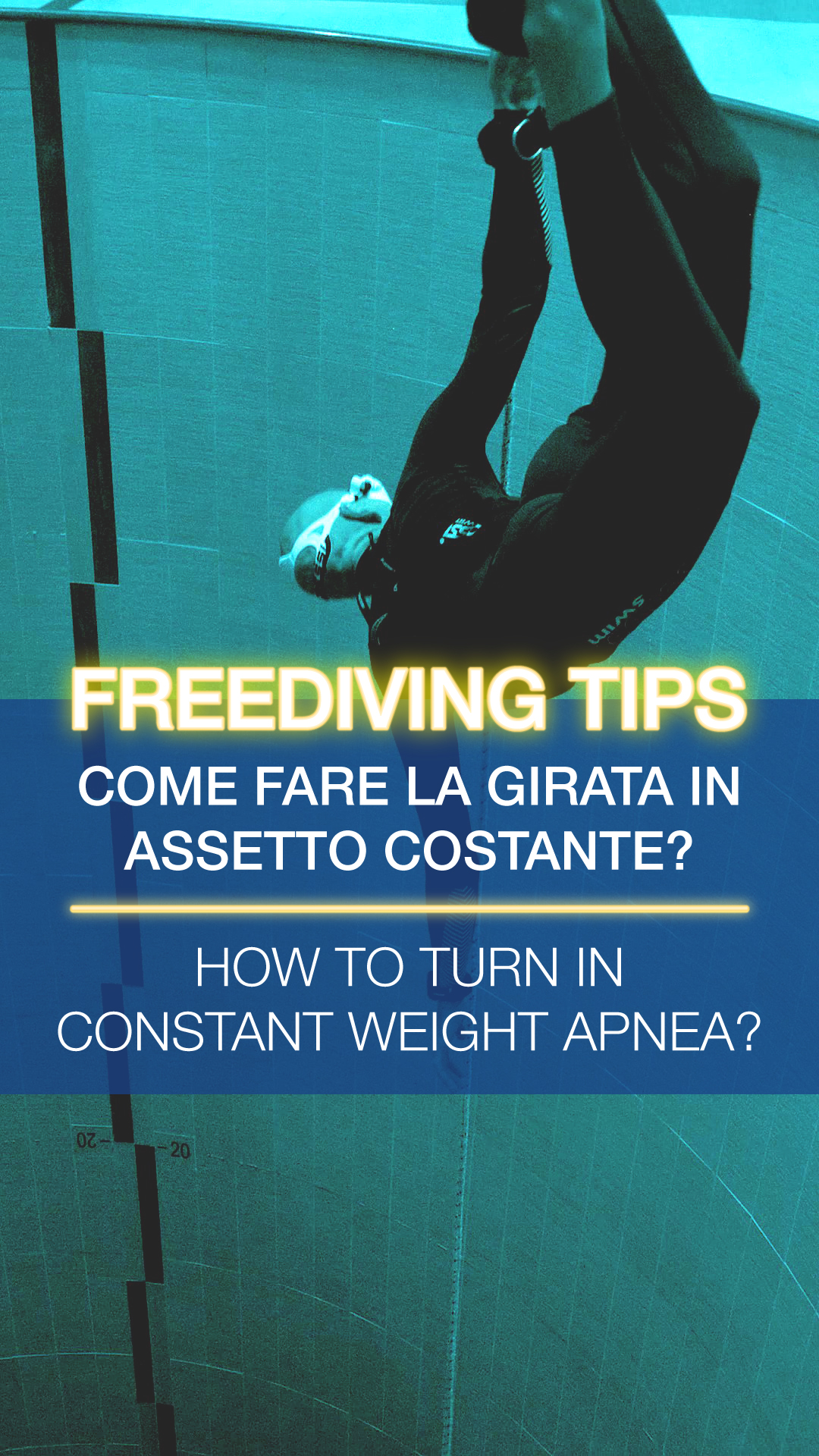
That’s the movement of the freediver who has reached maximum depth and decides to reverse the direction and return to the surface.
When the freediver gets to a certain depth in the fall, he grabs the cable with one hand, for example the right, and continues to fall with the left arm. When the arms are completely extended, the hand that grabbed the cable gives a pull and the body realigns with the head up and the freediver starts the ascend.
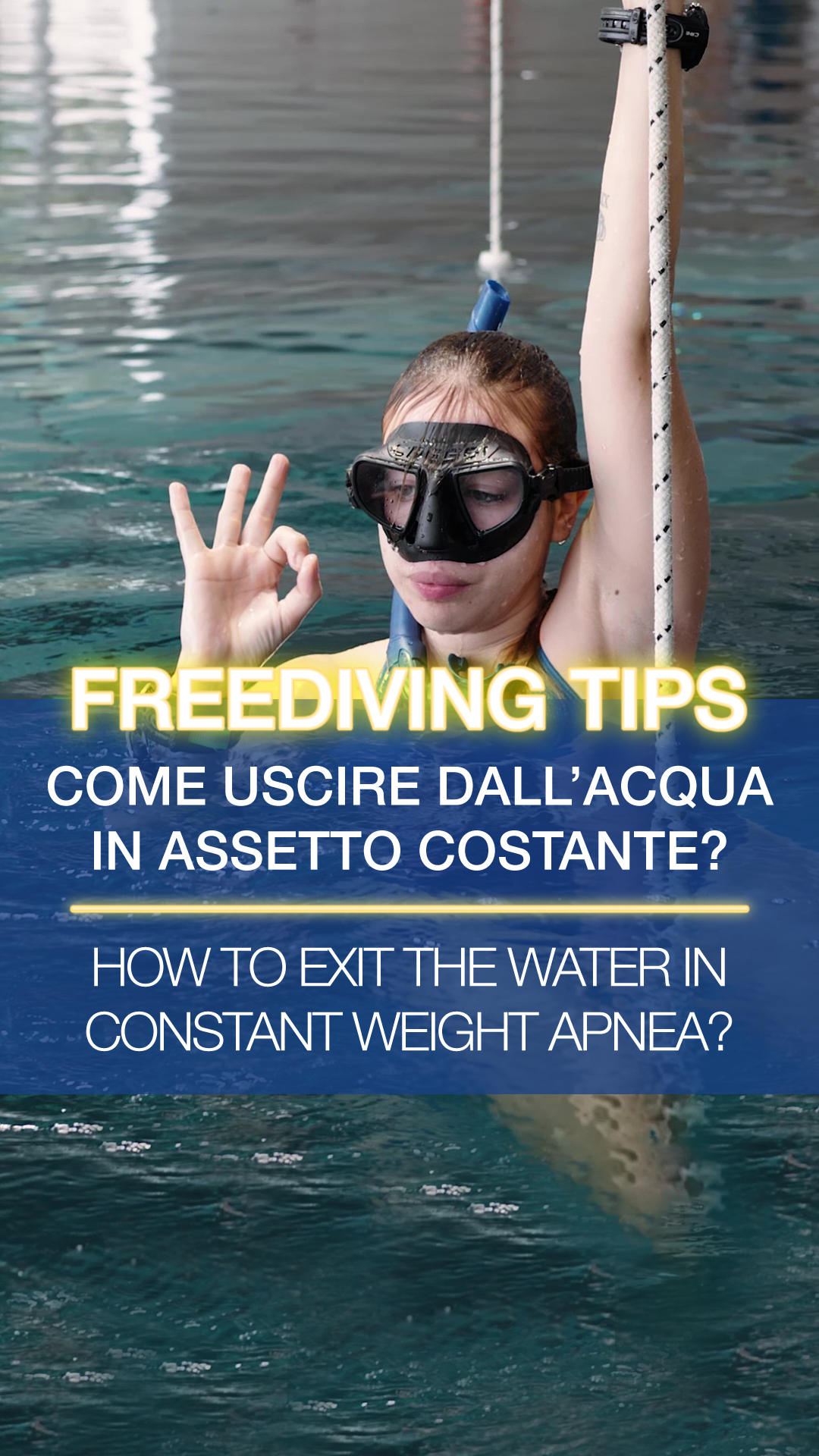
The exit is a very important moment. The freediver must be able to regain oxygen, but also have a stable position that does not make consume further. The freediver will possibly cling to the rope with the arm extended. Only the hand holding the rope will have to be stiffened. For the rest the freediver will just have to start breathing, so he’ll breathe out half the air he has stored in the lungs, breathe in fast, breathe out again. The exhalation takes place in a passive way, without pushing the air out, but it is very important to take air immediately in order to raise the level of oxygen that obviously after an apnea session could be low. After three breaths of this kind the freediver can give the okay and be reasonably sure to have no problems.
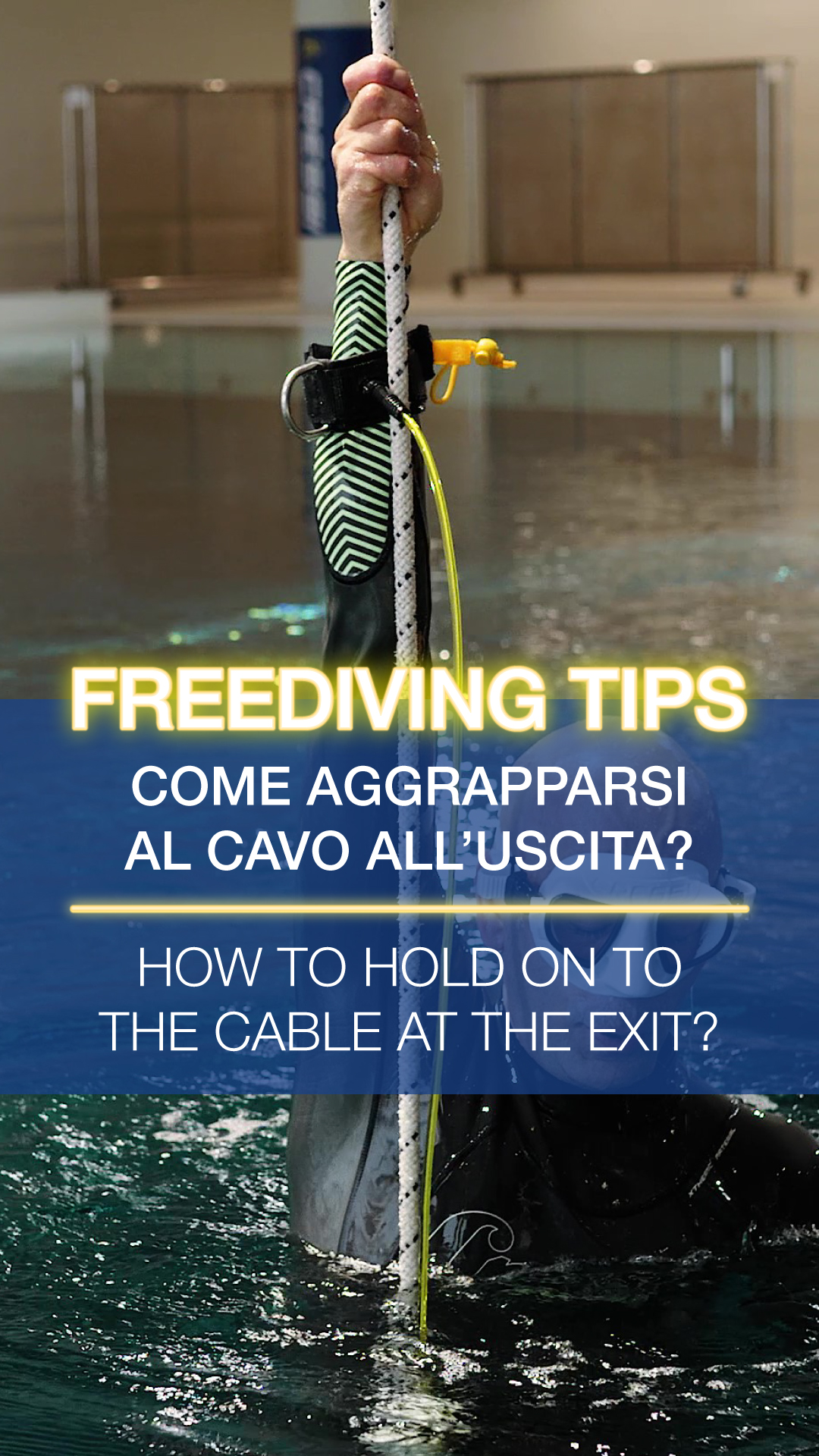
When we finish the freediving we will have to try to always stay close enough to the cable so as to be able to grasp it with the hand without major difficulties. Naturally each exit should be in control, therefore without having exaggerated, and without breathlessness in exiting, because the moment we reach the end of the apnea we have a low oxygen rate and pressure, and therefore we should be able to grasp in a few moments the cable and assume a stable and safe position with your mouth out of the water.
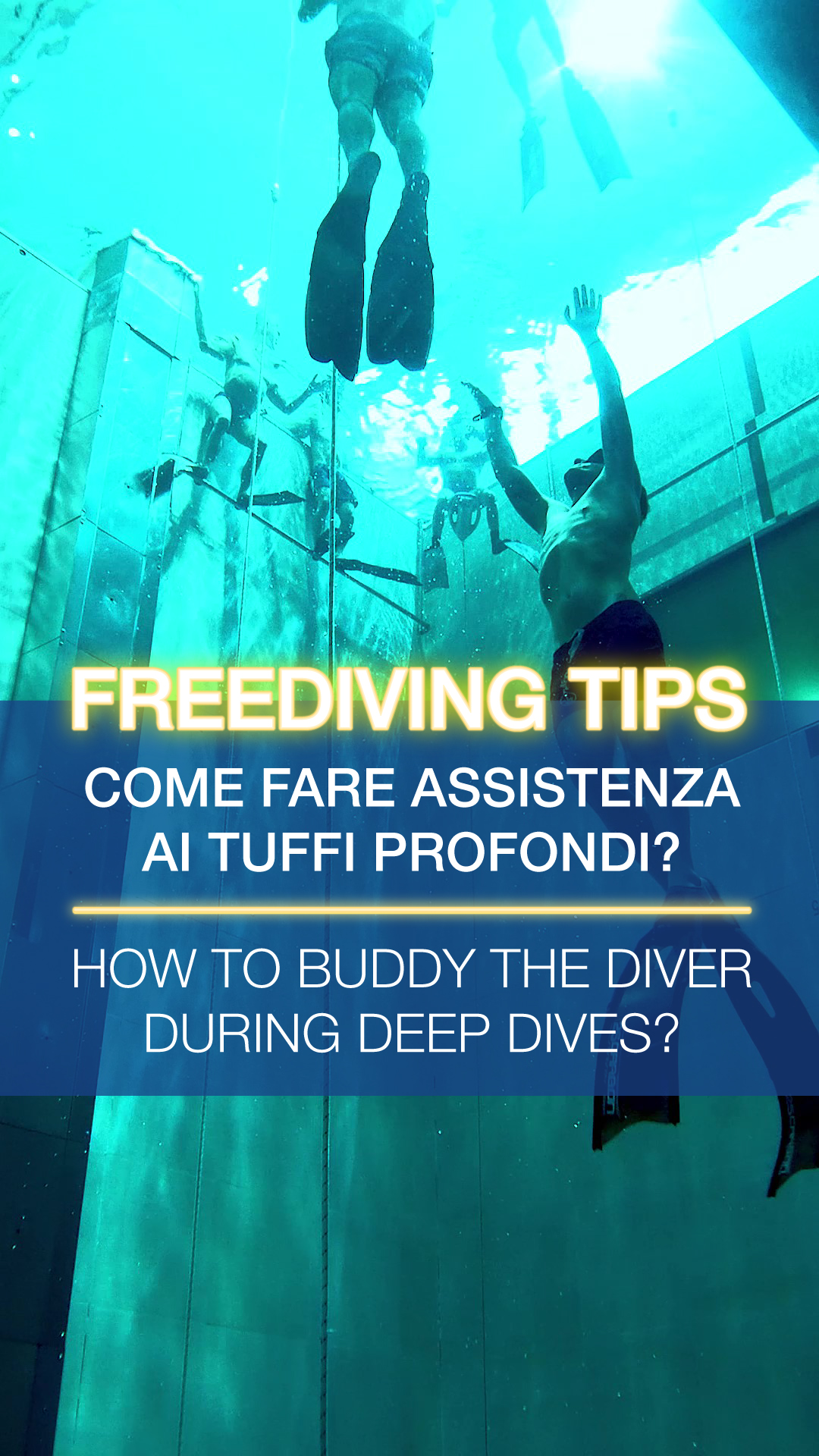
It’s important to know that you have a trusted partner who follows you from the surface. When you start to ascend, your partner will approach you, about a third of the way up, and will escort you to the surface, in front of you, slightly below by about a meter and ready to come to our rescue in case of difficulty. This is important in dives over 10/12 meters because it’s essential to train in absolute safety and tranquillity. Your partner will come close to you, watching you in the eyes to understand if you are able to emerge without problems.
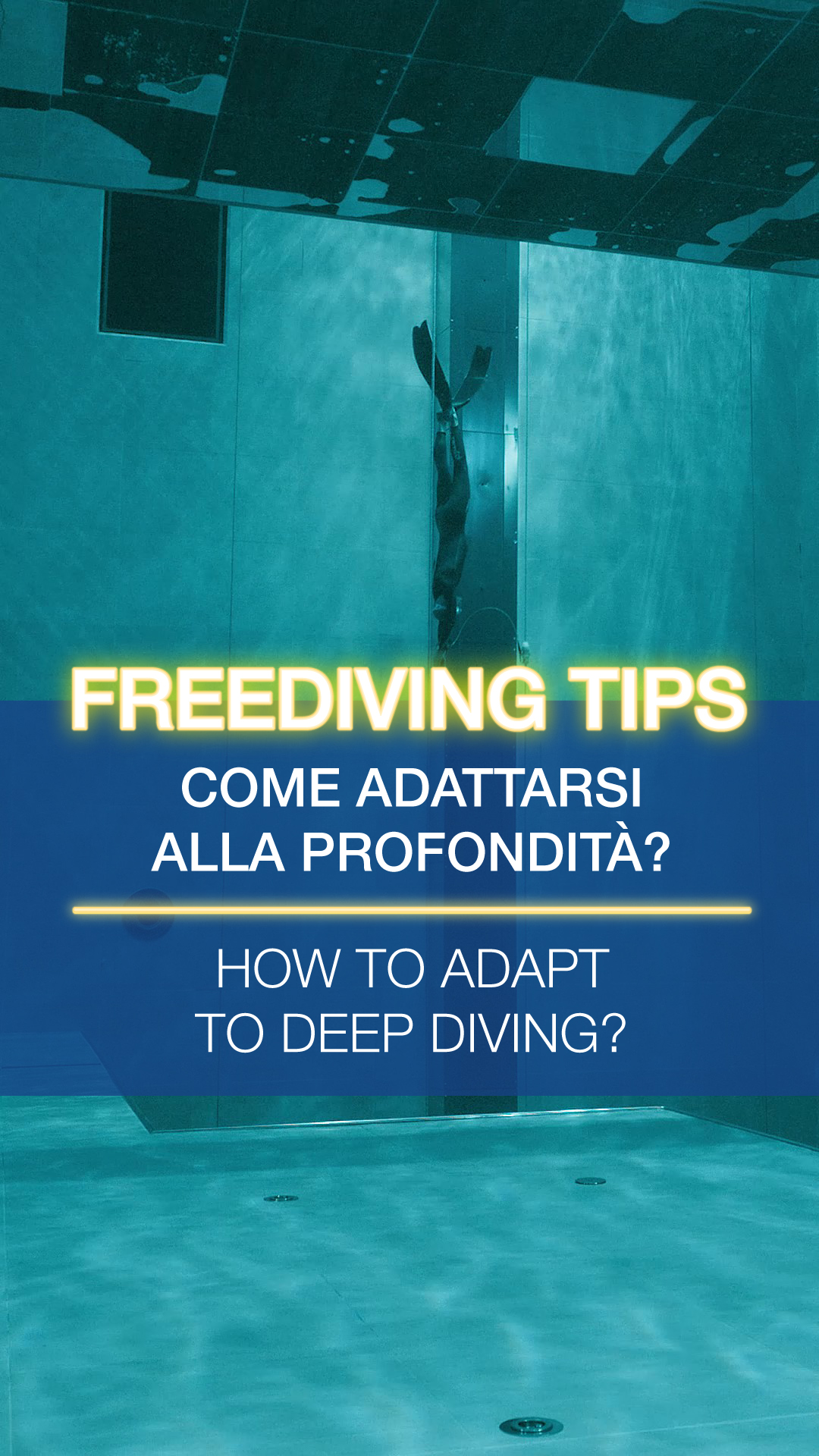
Usually it’s better if the freedivers adapt themselves with dives at increasing depth, so also the recovery and surface time need to be increasing. In the first dives the progression is important, especially if the freediver begins to have a certain training otherwise after four or five dives he will be tired. It is certainly important to have a good progression in the descents such as: five, ten, fifteen, twenty meters. In this way the freediver has the way to understand the relationship between the number of dives and the quality of them.
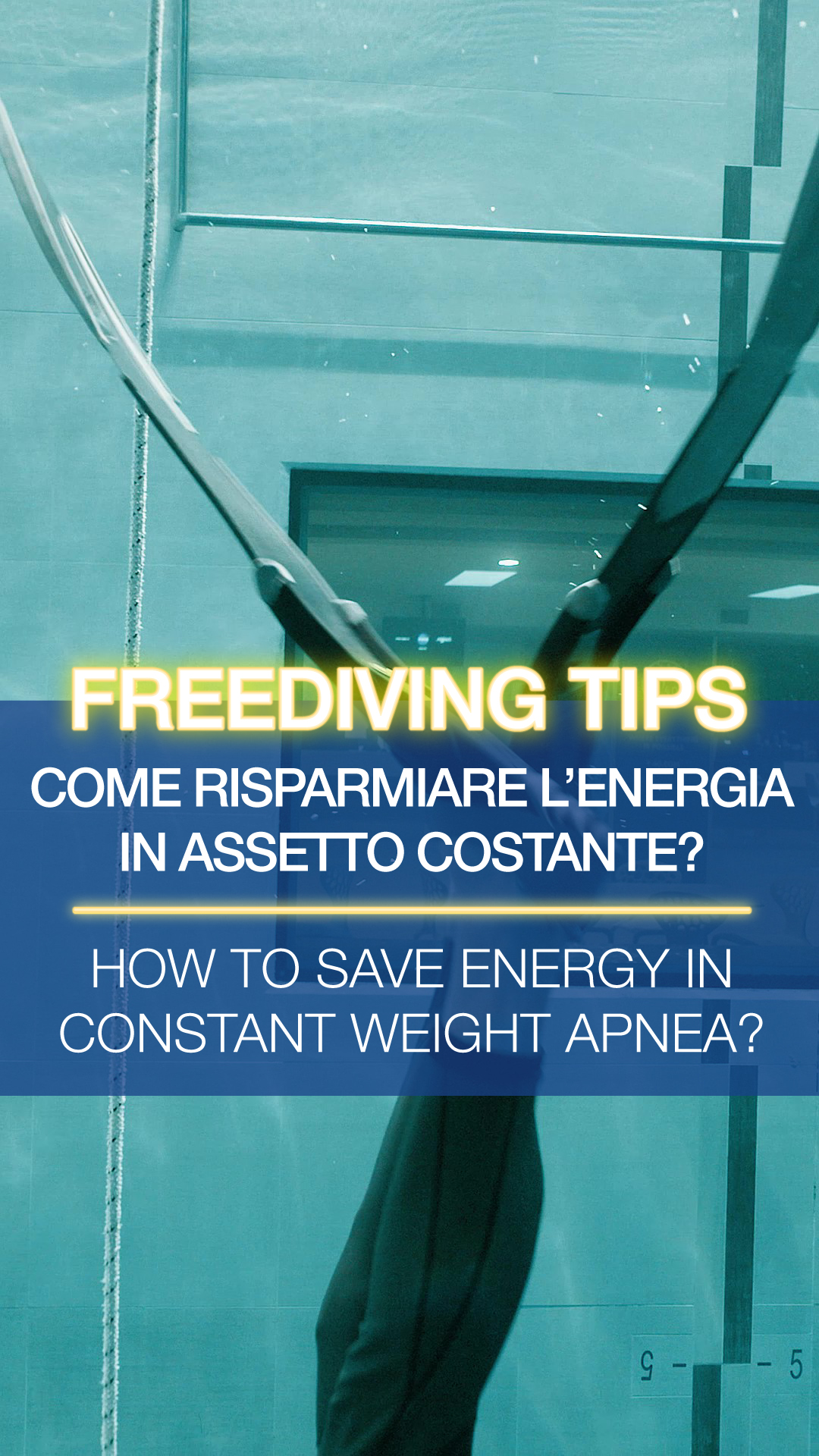
In constant weight apnea, many freedivers perform flutter kick giving too much power and this could be a problem. You should understand how to go down with the minimum energy expenditure. Kicks too wide, or too violent, can decrease the oxygen available to us and increase CO2, therefore, consequently, increasing the desire to breathe. You should learn that the intensity must be quite reduced compared to your abilities: it is fine if you want to train hard, but when you are performing deep dives you should limit consumption.
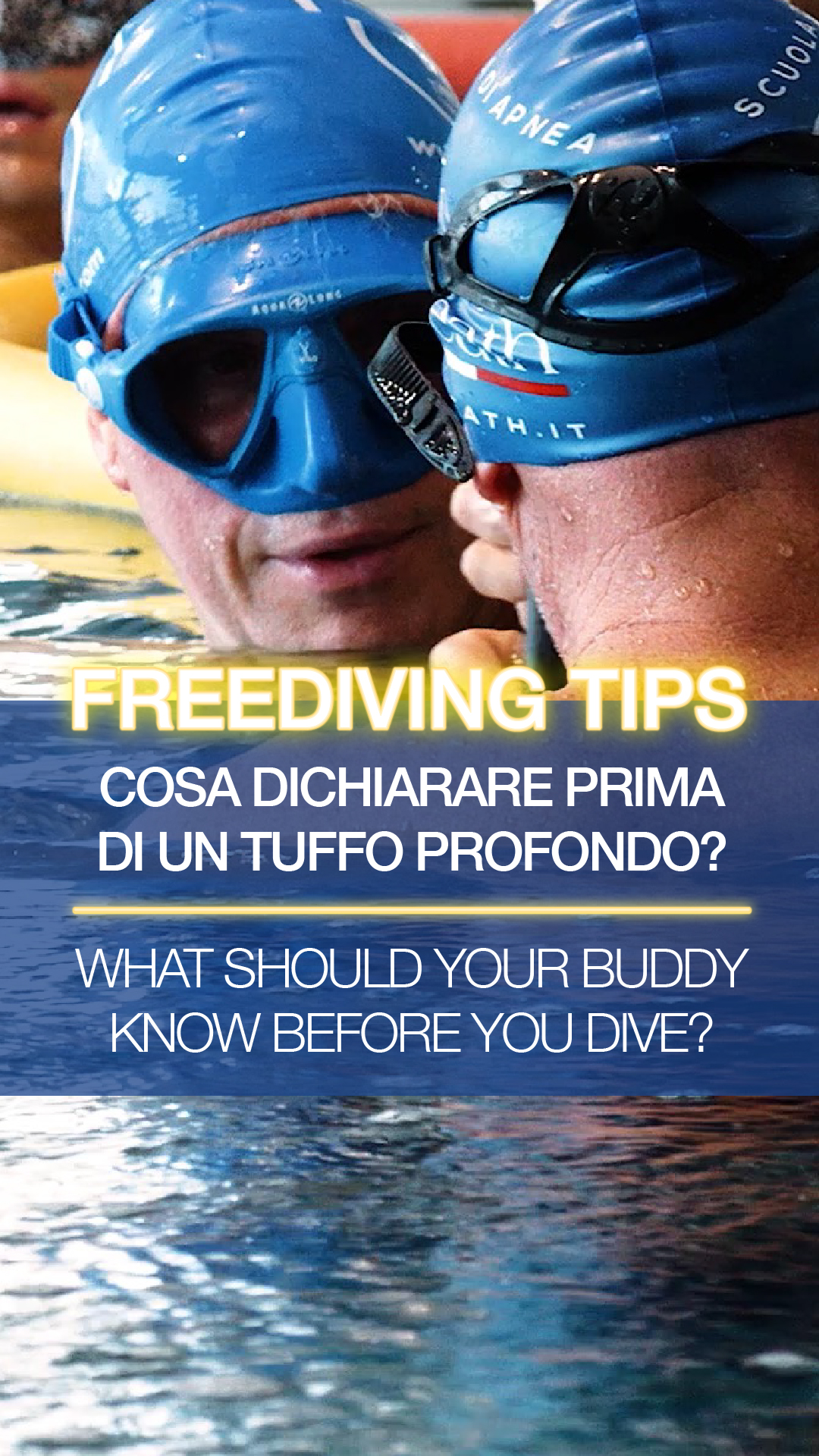
When you dive, it’s important to declare to your partner whatever you are going to do: the technique, the depth, a possible stop or a particular exit technique. Your buddy who acts as a rescuer needs to know everything, so he can help you efficiently.
ALLENAMENTO
The number of times depends on the type of training and the goal you want to achieve. If the goal is generic, as a general improvement of apnea, the workouts to be faced will be static, dynamic and depth. It also depends on the tools used: bifin, monofin or breaststroke. It is necessary to tone the body, working on breathing exercises and on the mental approach, which must be reflective, relaxed, not fearful or excessively swaggering. Three weekly workouts in the water can be useful, making one in depth, one in dynamics and one in statics, but it depends on the logistics and on your own possibilities, but also on the seasons of the year. Initially, in the autumn-winter months we should work on physical preparation, then on dynamics and finally, towards summer or late spring on activities in depth.
It’s important to have a good aerobic preparation, doing cross-country sport, cycling, skating, running. However, there are also people who can’t spend many hours in the water a week, but want to prepare for dry apnea. This is possible with the series of statics or walking or running holding the breath. Some world champions prepared records walking at different intensities in apnea. This is a great way to maximize the time we have out of the water. Then there are other athletes who work exclusively in the water. Freediving is a particular sport because there are many people who have achieved world-class goals by training in different ways.
ANXIETY
Does apnea help to manage anxiety?
Apnea is useful in breath education because it involves and exercises organs and muscles of the respiratory system. Breathing brings oxygen into the body and intervenes in our circulation. Learning to inhale and exhale well involves the whole organism, so much so that breathing correctly, deeply and rhythmically, offers many benefits: it reduces anxiety and stress, improves circulation and promotes greater relaxation.
Can you learn to breathe?
Breathing is a spontaneous, survival act. However, there are correct techniques useful to learn to improve it. Focusing on yourself, in correctly managing inhalation and exhalation, helps the parasympathetic nervous system to activate, promoting mental and physical relaxation. Knowing how to breathe well helps the cardiovascular system, relieves stress, and promotes sleep.
Can apnea prevent us from breathing poorly?
When we breathe poorly, the whole body is affected. We can put pressure on organs such as the heart and brain, making it difficult to concentrate, sleep and manage emotions. Knowing apnea breathing techniques is very helpful in mastering moments of tension and anxiety in daily life. It is no coincidence that, since childhood, in moments of agitation or fear we hear the advice “Stop and breathe,” “Take a deep breath,” “Breathe with your belly”-all suggestions that see correct breathing as the solution to problems.
What stressful and anxious situations can be managed through typical apnea breathing techniques?
In general, many tense moments can be eased or slowed down. Whether it is a school or university exam, a job interview, a public speaking engagement, a sports competition, an important meeting, a medical procedure, or, in general, something for which we feel challenged or that arouses fear, concentrating on breathing, knowing how to improve and lengthen the exhalation time, can help you relax mentally and physically.
Cosa accade se respiro solo in maniera istintiva e non so respirare bene?
La respirazione è un atto sia organico che mentale. Se fatto male, posso rischiare di scatenare l’ansia e lo stress ogni volta in cui viva dei momenti di tensione o di timore. Ogni volta che ho paura o che mi sento messo alla prova, devo sapere gestire il flusso del mio respiro, una dinamica esercitata attraverso le tecniche di respirazione che si possono apprendere, ad esempio, in un corso di apnea.
Saper respirare bene aiuta il sonno?
Sì, le tecniche di respirazione, apprese anche nel rilassamento in apnea, sono utili a contrastare l’insonnia, perché, migliorando il ritmo cardiovascolare, buttiamo fuori le tossine, favorendo il nostro equilibrio. Respirando correttamente contrastiamo lo stress, aiutiamo il cuore e facciamo calare la pressione sanguigna. Il cervello raggiunge così una maggiore stabilità e calma e va da sé che questo rilassamento concili il sonno.
Una buona tecnica di respirazione può migliorare la propria salute mentale?
Sapere respirare bene è utile sia a livello organico che mentale. D’altronde il nostro organismo attraverso l’inspirazione acquisisce quello che è utile alla sua vita cellulare, mentre poi con l’espirazione emette ciò che va buttato via. Alla stessa maniera, è utile alla nostra salute e stabilità mentale: regola il sistema emozionale, affettivo, di equilibrio e di controllo dello stress.
Le tecniche di apnea possono fungere da ansiolitici?
Le tecniche di respirazione apprese con l’apnea insegnano a riempire e svuotare i polmoni nel modo corretto e questo placa l’ansia. Respirare lentamente, con le modalità e le tempistiche corrette è utile a star bene, alla maniera in cui suggerivano le antiche discipline orientali, dalla meditazione allo yoga, educando il respiro per fare funzionare meglio tutto l’organismo.
Cosa può essere migliorato dal respiro e dall’apnea?
Il respiro ed il suo trattenimento possono servire a regolare gli indici di stress, tensione, stanchezza, fatica e ansia. Sapere come respirare e come stare in apnea migliora l’equilibrio, la concentrazione, la partecipazione, la consapevolezza e la gestione delle emozioni, consentendoci di superare gli ostacoli, di dare di più e fruire delle nostre abilità.
È importante anche per i bambini saper respirare bene?
È importantissimo soprattutto per i bambini che sfiorano l’iperattività, soffrono di Adhd, o che comunque fin da giovanissimi vivono tensioni e problematiche legate allo stress a causa dei ritmi frenetici, degli stimoli esagerati e delle prime paure. Insegnare ai bambini delle piccole tecniche di respiro, anche come forma di gioco in acqua o all’asciutto guardando il gonfiarsi e sgonfiarsi della pancia, altro non è che dar loro le chiavi verso i primissimi modi per raggiungere un buon livello di benessere fin dall’infanzia, senza accumulare ansie, ma imparando a sentire e gestire in maniera positiva le emozioni, con la spontaneità di chi si è staccato da poco dal liquido amniotico.
Le tecniche di apnea sono utili anche per altri sport?
Le tecniche legate alla respirazione e all’apnea risultano utili in tutti gli sport. Non solo perché in numerose discipline sportive ci sono alcuni momenti in cui, quasi senza rendersene conto, si trattiene il fiato, ma anche perché in attività più di fondo, come la corsa o il nuoto, il proprio rendimento può migliorare conquistando quello che si definisce marginal gain, ovvero un piccolo miglioramento incrementale in più aree (respirazione, alimentazione…) allo scopo di ottimizzare le prestazioni complessive.